How to Optimize Your AI Prompts: Step-by-Step Guide
Why optimize your AI prompts?
Most generative AI users settle for "good enough" results. They type a quick question, get an average answer, and spend time manually reworking it. This is a considerable waste of time. An optimized prompt can produce a directly usable result on the first attempt, requiring little or no modification.
Prompt optimization is not reserved for technical experts. It is an accessible skill that relies on a simple, reproducible method. Whether you use ChatGPT, Claude, Gemini, or any other model, the fundamental principles remain the same.
What optimization actually changes
- 5 to 10x better results: more precise, more relevant, more actionable responses.
- Time reduction: fewer back-and-forths, fewer manual corrections.
- Increased consistency: predictable and reproducible results.
- Better ROI: if you pay per use (API), fewer wasted tokens.
The 5-step method to optimize your prompts
Step 1: Analyze the current result
Before optimizing, you need to understand where your current prompt stands. Send your prompt as-is and analyze the result by asking: Does the result answer the right question? Is the detail level appropriate? Does the tone match? Is the format usable? Are there missing or incorrect elements?
Rate each aspect on a 1-5 scale. The lowest-rated aspects are your optimization priorities.
Step 2: Identify the gaps
Gaps are the differences between what you got and what you wanted. They typically fall into categories:
- Understanding gap: the AI misunderstood. Cause: ambiguous instructions.
- Context gap: the AI understood but lacked information. Cause: insufficient context.
- Format gap: good content, wrong format. Cause: no format specification.
- Quality gap: correct but not up to standard. Cause: no quality criteria.
- Scope gap: too broad or too narrow. Cause: missing constraints.
Step 3: Add relevant context
Context is the most powerful optimization lever. Add information that helps the AI better understand your situation: your role, the final objective, the audience, real constraints, and previous results.
Before: "Give me marketing content ideas."
After: "I'm the marketing manager of a French B2B SaaS startup (project management tool) targeting SMBs with 20-200 employees. Our blog gets 5,000 visits/month and we want to double traffic in 6 months via SEO. Suggest 10 SEO-optimized blog ideas with title, target keyword, estimated search volume, and a 3-5 point outline for each."
Step 4: Adjust constraints
Constraints transform generic results into tailored ones. Specify precise length, imposed structure, explicit prohibitions, technical level, and concrete examples to include.
Step 5: Iterate and validate
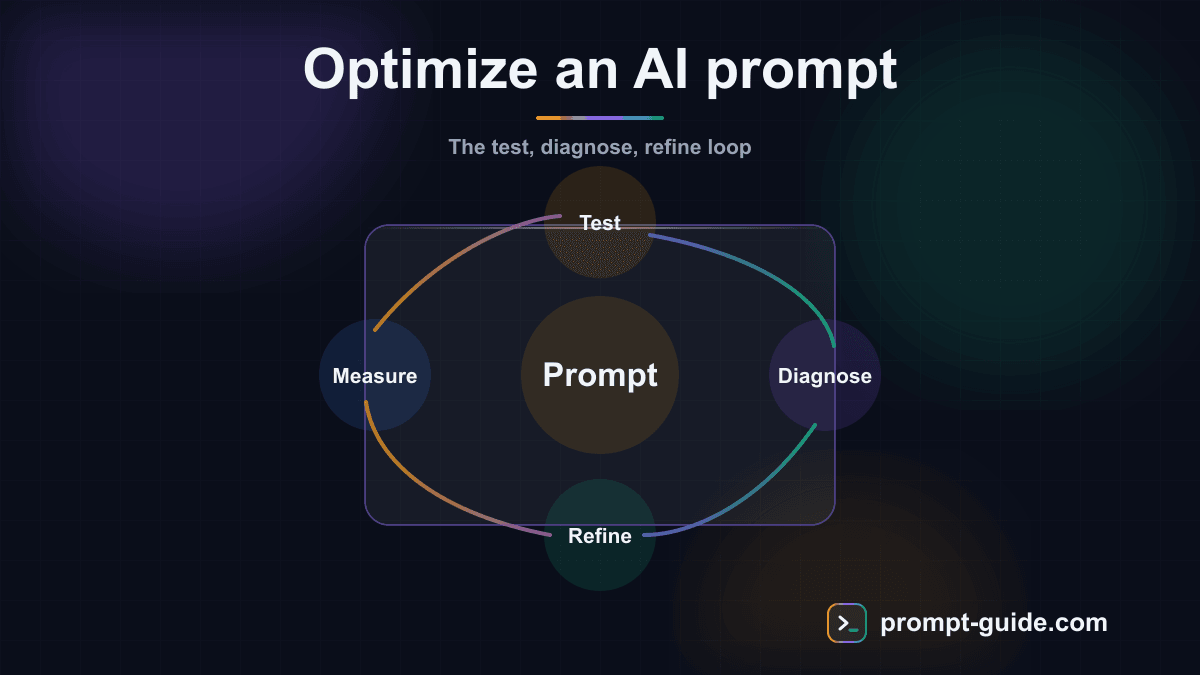
Optimization does not stop at one cycle. After applying steps 1-4, rerun the optimized prompt and evaluate again. Usually 2-3 iterations are enough to reach excellent results.
Before/after examples
Example 1: Marketing copy
Before: "Write a sales page for my product."
After: "You are a B2B SaaS copywriter. Write a landing page for [product], a project management tool for SMBs. Target: SMB leaders frustrated by overly complex tools. Value prop: simplicity + fast ROI. Structure: emotional hook → problem → solution → 3 key benefits with data → 2 realistic testimonials → CTA. Professional tone, no jargon. 600-800 words."
Example 2: Data analysis
Before: "Analyze these sales data."
After: "You are a senior data analyst. Here is my Q3 2025 sales data: [data]. Identify: 1) top 3 trends, 2) anomalies, 3) product correlations. For each insight, provide confidence level (high/medium/low) and recommended action. Present in a summary table followed by a 100-word synthesis."
Common optimization mistakes
- Over-engineering: a 500-word prompt for a simple task is counterproductive. Prompt complexity should match task complexity.
- Ignoring model specifics: each model has strengths and weaknesses. Claude excels with XML-structured prompts; ChatGPT is more flexible with natural language.
- Skipping reproducibility testing: test prompts multiple times to ensure consistent quality.
- Blind copy-pasting: always adapt online templates to your specific context.
- Not saving prompts: build a personal library of optimized prompts organized by use case.
Optimization assistance tools
You can use the AI itself to optimize prompts (Meta-Prompting). Specialized platforms like Prompt Guide, OpenAI Playground, Anthropic Console, and LangSmith also offer advanced testing and evaluation features.
For self-evaluation, ask three questions: Would a colleague understand exactly what I want? Would I know what to do with this result tomorrow? Have I given the AI as much information as I would a human colleague? These three questions cover 80% of prompting issues.
Related Prompts
Write a Complete SEO Blog Article
Creates a complete, structured blog article optimized for search engines with all necessary tags and sections.
Improve your decision-making with AI
Make informed decisions through structured multi-criteria analysis with decision matrix, scenarios, and reasoned recommendations.
Write a High-Impact B2B Prospecting Email
This prompt generates short, personalized, results-oriented B2B prospecting emails with an optimized response rate thanks to a proven structure.
Create a Detailed and Structured Blog Post Outline
Create detailed blog post outlines with SEO structure, preliminary research, and supplementary elements.
Create a complete and effective FAQ
Create a complete and structured FAQ that reduces support requests with clear answers, a decision tree, and SEO optimization.
Executive Summary of a Long Document
Transforms a long document into a structured executive summary with conclusions, attention points, and actionable recommendations for decision-makers.
Practice Exercises
Clarity and Precision
Learn to write clear and precise prompts to get exactly what you want.
Providing Context
Master the art of giving the right context to AI for relevant results.
Defining Output Format
Learn to specify the exact format of the expected response.
Constraints and Limitations
Master advanced constraints for professional results.
Optimization and Iteration
Improve a prompt through 3 successive iterations.
Related guides
Continue your learning
You've finished this guide. Here's how to go further.
Practice what you learned
Interactive exercises to sharpen your prompting skills
Get new guides every week
Join our newsletter and never miss new content.