Prompting Guide for Digital Marketing
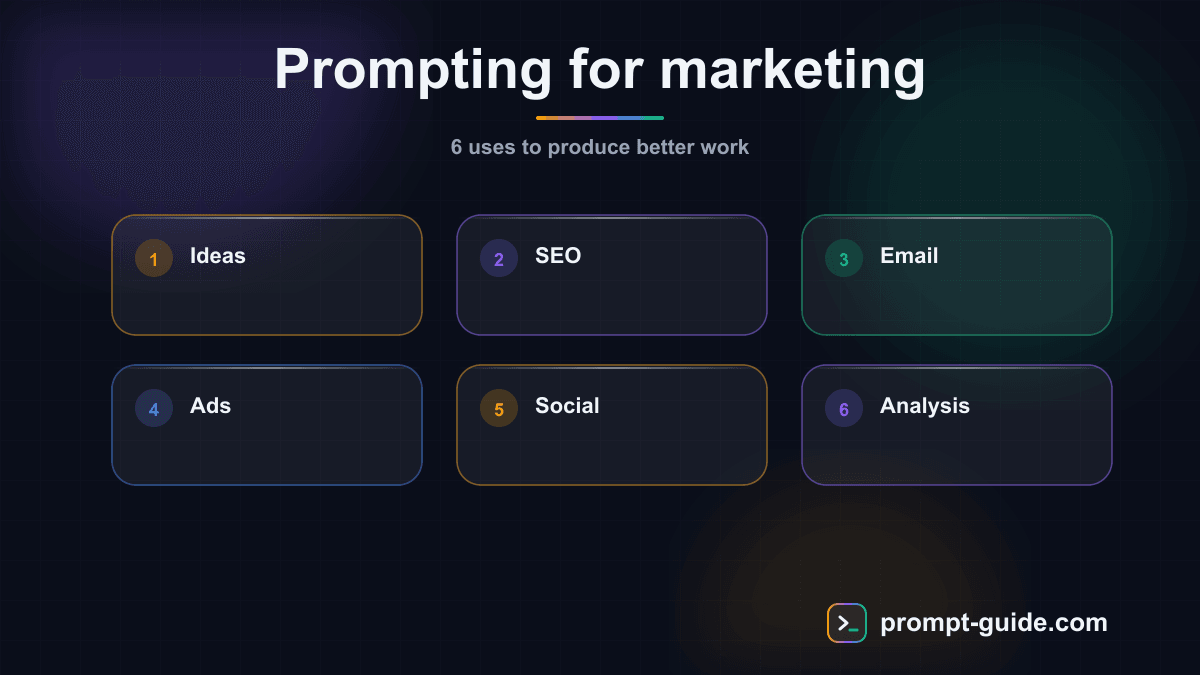
Prompts for Copywriting
Copywriting is one of the areas where AI delivers the most value — if you know how to guide it. A well-crafted copywriting prompt produces persuasive text that's tailored to your audience and consistent with your brand identity.
Copywriting Fundamentals with AI
For excellent copy, your prompt should always include:
- Precise targeting: demographics, psychographics, problem awareness level
- Conversion objective: click, sign-up, purchase, booking
- Brand tone: professional, casual, provocative, inspiring
- Copywriting framework: AIDA, PAS, BAB, 4P — specify it to structure the response
- Constraints: length, keywords to integrate, desired CTA
Sales Page Template Prompt
You are a conversion copywriter specialized in e-commerce. Write a sales page for [product] using the PAS framework (Problem - Agitation - Solution). Target: [audience]. Tone: [tone]. Include: a catchy headline, 3 body paragraphs, 5 benefit bullet points, a credible fictional testimonial, and a compelling CTA. The page should create urgency without being aggressive.
A/B Testing Copies with AI
Here is my current text for [element: CTA button / email subject / landing page headline]: "[current text]". Generate 5 alternative variants varying: emotional framing (fear vs desire), length, specificity level, and type of proof used. For each variant, predict which audience segment will respond best and why.
SEO Prompts
SEO is an ideal playground for prompting. From keyword research to optimized content writing, AI can accelerate every step of your organic search strategy.
Keyword Research
You are an SEO expert. For the topic "[topic]", generate a list of 30 keywords organized into thematic clusters. For each keyword, indicate: 1) search intent (informational, transactional, navigational), 2) estimated difficulty (easy/medium/hard), 3) an associated content idea. Prioritize long-tail keywords with high conversion potential.
SEO Article Writing
You are an experienced SEO content writer. Write a 1500-word article on "[topic]" optimized for the primary keyword "[keyword]" and secondary keywords [list]. Structure: engaging introduction, 4-5 H2 subheadings with H3s if needed, conclusion with CTA. Follow Google's E-E-A-T best practices: cite sources, share concrete expertise, integrate data. Keyword density: natural (1-2%).
Meta Tag Optimization
Here is my page content [URL or content summary]. Write 3 title tag variants (max 60 characters) and 3 meta description variants (max 155 characters) optimized for the keyword "[keyword]". Each variant must: include the keyword, contain a clear benefit, encourage clicks, and be unique.
Social Media Prompts
Social media demands abundant, varied, and engaging content. AI helps you maintain a sustained publishing cadence without sacrificing quality.
Editorial Calendar
You are an expert social media manager. Create a 4-week editorial calendar for [brand] on [platform(s)]. Context: [industry], audience [description], main objective [goal]. For each post, indicate: 1) optimal posting day and time, 2) content type (carousel, video, infographic, text), 3) topic, 4) opening hook (first 2 lines), 5) recommended hashtags. Ensure content variety: 40% educational, 30% engaging, 20% promotional, 10% behind-the-scenes.
LinkedIn Posts
You are a LinkedIn ghostwriter specialized in B2B personal branding. Write a LinkedIn post about "[topic]" for [profile: CEO/manager/consultant]. Format: compelling hook (1 line that stops the scroll), development in short paragraphs (1-2 sentences max), bullet points if relevant, conclusion with open question to generate comments. Tone: authentic, not corporate. Length: 150-200 words.
Email Marketing Prompts
Email marketing remains one of the most profitable digital marketing channels, with an average ROI of $42 for every dollar spent. AI can transform your email campaigns into true conversion machines.
Onboarding Sequence
You are an email marketing automation expert. Design a 5-email onboarding sequence for [business/product type]. Context: the new subscriber [initial conversion action]. For each email, provide: 1) send timing (D+X), 2) subject line (2 A/B variants), 3) preview text, 4) email body (150-200 words), 5) primary CTA, 6) the email's objective in the sequence.
Abandoned Cart Recovery
Write a 3-email abandoned cart recovery sequence for [e-commerce store type]. Email 1 (H+1): gentle reminder and help. Email 2 (H+24): benefits and social proof. Email 3 (H+72): urgency and special offer. For each email: catchy subject line (2 variants), concise body (100-150 words), CTA.
Marketing Data Analysis
AI doesn't replace your analytics tools, but it excels at interpreting data, identifying patterns, and recommending concrete actions.
Metrics Interpretation
You are a senior marketing analyst. Here are my [campaign type] metrics for [period]: [list metrics: impressions, clicks, CTR, conversions, CPA, ROAS, etc.]. My industry benchmark is [benchmarks if available]. Analyze this data and provide: 1) a 3-point diagnosis, 2) any warning signals, 3) optimization opportunities, 4) a prioritized action plan with estimated impact.
Content Strategy with AI
Beyond individual content creation, AI can help you build a coherent, scalable, and data-driven content strategy.
Content Hub Strategy
You are a content marketing and SEO expert. Design a content hub strategy for [company] on the topic "[topic]". Create: 1) a pillar page (definition, angle, target keywords), 2) 10 satellite articles with their keywords and logical link to the pillar page, 3) internal linking between articles, 4) a 3-month publishing calendar, 5) success metrics to track.
Content Repurposing
Here is a 2000-word blog article about "[topic]". Propose a repurposing plan in 10 different formats: LinkedIn posts, Twitter thread, Instagram carousel, short video script, infographic, email newsletter, podcast episode notes, and a downloadable practical guide. For each format, adapt the tone and length to the platform.
Find our ready-to-use marketing prompts in our library, and perfect your techniques with our practical exercises.
Related Prompts
Create a Complete Monthly Editorial Calendar with AI
This prompt generates a detailed monthly editorial calendar with weekly themes, day-by-day planning, formats, hooks and KPIs for all your communication channels.
Create an Editorial Style Guide for a Brand
This prompt produces an operational editorial style guide that ensures consistent brand voice across all channels, even with multiple writers.
Write LinkedIn Posts That Drive Engagement
Create structured, engaging LinkedIn posts with compelling hooks, storytelling and CTAs optimized for your audience.
Design a Complete High-Performance Email Marketing Sequence
A comprehensive prompt to generate a structured email marketing sequence with copywriting, segmentation, branching conditions and tracking KPIs.
Optimize a Landing Page to Boost Conversions
A comprehensive prompt to analyze and optimize every element of a landing page: headline, copywriting, CTA, social proof and A/B testing plan.
Create a Detailed Buyer Persona for Your Target Market
This prompt generates an ultra-detailed buyer persona that goes far beyond demographics, capturing the psychology and behaviors that drive purchasing decisions.
Practice Exercises
Clarity and Precision
Learn to write clear and precise prompts to get exactly what you want.
Providing Context
Master the art of giving the right context to AI for relevant results.
Defining Output Format
Learn to specify the exact format of the expected response.
Role Prompting
Use role assignment to get expert-level responses.
Few-shot Prompting
Teach by example: guide the AI with concrete examples.
Related guides
Continue your learning
You've finished this guide. Here's how to go further.
Practice what you learned
Interactive exercises to sharpen your prompting skills
Get new guides every week
Join our newsletter and never miss new content.