Prompting Guide for HR & Recruitment
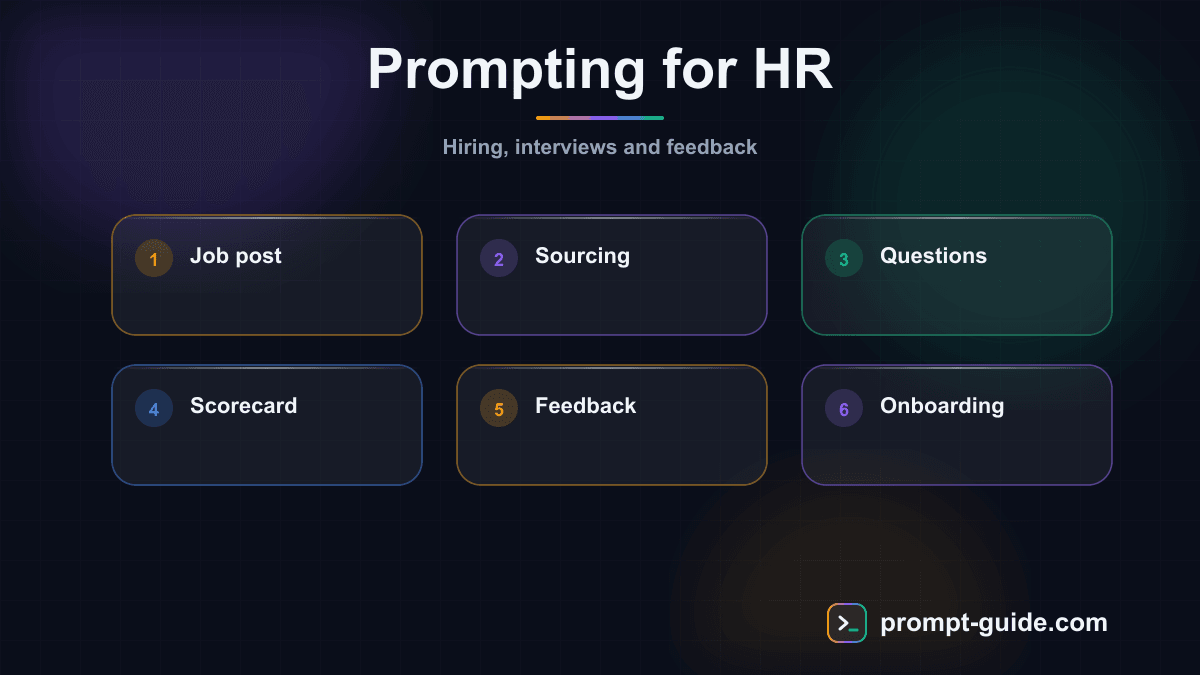
Writing Job Postings with AI
The job posting is the first point of contact between your company and potential candidates. Yet most job ads look alike, use disconnected corporate language, and don't sufficiently highlight what makes the role and company unique. AI can transform your postings into genuine talent magnets — if you guide it well.
Elements of an Effective Job Posting Prompt
To generate a standout job posting, your prompt should contain:
- Company context: size, industry, culture, growth stage, values
- The specific role: title, team, reporting structure, role stakes
- Desired profile: technical skills, soft skills, experience level
- Differentiating benefits: not just "health insurance" but what genuinely makes the company attractive
- Desired tone: corporate, casual startup, inclusive, technical
- Legal constraints: gender-neutral language, non-discrimination, GDPR compliance
Complete Job Posting Template Prompt
You are an employer branding expert specializing in inclusive job postings. Write a job posting for a [title] position at [company name]. Context: [industry, size, stage, culture]. The team: [team and manager description]. Key responsibilities: [5-7 responsibilities]. Ideal profile: [skills and experience]. Our benefits: [list]. Write the posting following these rules: 1) Tone [describe tone], 2) Inclusive language, 3) Clear structure with distinct sections, 4) Put candidate benefits before requirements, 5) Avoid hollow HR jargon ("dynamic," "proactive," "team player"), 6) Include a salary range [range] and work modalities (remote/hybrid/on-site), 7) End with a transparent recruitment process.
Adapting a Posting for Different Channels
Here is our complete job posting for a [title] position: [paste posting]. Adapt it for these 4 channels: 1) LinkedIn (engaging 200-word post with relevant emojis and CTA), 2) Indeed/Glassdoor (classic structured format optimized for search filters), 3) Company careers site (complete SEO-optimized version), 4) Direct sourcing message (personalized LinkedIn InMail, 100 words max, direct and human).
Application Screening
Screening is the most time-consuming step in recruitment. AI can help you structure your evaluation, create consistent scoring grids, and prepare summaries — while keeping humans at the center of the final decision.
CV Evaluation Grid
You are a senior recruiter specialized in [industry]. I'm hiring for a [title] position. Here are the essential criteria: [weighted criteria list: technical 40%, experience 30%, soft skills 20%, education 10%]. Create a CV evaluation grid as a table with: 1) each criterion and sub-criterion, 2) a 1-5 rating scale with descriptors for each level, 3) weighting for each criterion, 4) a minimum threshold to advance. The grid must be objective, reproducible, and non-discriminatory.
Candidate Summary for Hiring Manager
Here is a candidate's CV and cover letter for the [title] position: [key elements summary]. Write a summary sheet for the hiring manager including: 1) 3-sentence profile summary, 2) fit against 5 key job criteria (gauge: low/medium/high), 3) top 3 strengths, 4) 2 areas of concern, 5) recommended interview questions, 6) verdict: priority / interesting / not a match.
Interviews and Evaluation
AI can considerably improve your interview quality by helping you prepare relevant questions, structure the evaluation, and reduce biases.
Structured Interview Preparation
You are an expert in recruitment interview techniques. Prepare a 45-minute structured interview guide for the [title] position. Competencies to evaluate: [list]. For each competency, provide: 1) 2 behavioral questions (STAR method: Situation, Task, Action, Result), 2) response elements to look for (positive and negative indicators), 3) a 4-level rating scale with behavioral descriptors. Include: 2-minute introduction (putting at ease), timing per section, and 5 minutes for candidate questions.
Practical Case / Role Play
Create a 30-minute practical case to evaluate a candidate for the [title] position. The case should: 1) simulate a realistic job situation, 2) test competencies [list], 3) have appropriate complexity for [seniority level], 4) allow multiple valid approaches (not just one right answer), 5) include sufficient data to work with without being overwhelming. Provide: the candidate brief, the recruiter's evaluation grid with criteria and levels, and examples of expected good answers.
Training and Onboarding
Onboarding is a critical moment: 20% of turnover happens within the first 45 days. AI can help you create structured integration programs and engaging training programs.
Personalized Onboarding Plan
You are an employee experience expert. Create a 90-day onboarding plan for a new [job title] joining [company type]. Context: team of [size], manager [profile], culture [description]. Structure the plan in 3 phases: 1) Week 1-2: Discovery (welcome, culture, tools, key meetings), 2) Week 3-6: Skill building (training, guided first projects, 360 feedback), 3) Week 7-12: Progressive autonomy (independent projects, measurable goals, probation review). For each week, indicate activities, people to meet, expected deliverables, and checkpoints.
Training Module Creation
Design a [duration] training module on "[topic]" for [audience: new managers / sales team / all employees]. Learning objectives: [list]. The module should include: 1) an engaging introduction showing the concrete stakes, 2) theoretical content in 3-4 blocks (20 minutes max each), 3) a practical exercise per block, 4) a 10-question assessment quiz, 5) a recap cheat sheet, 6) resources for further learning. Approach: 70% practical, 30% theoretical.
Internal Communications
Internal communication is the cement of company culture. AI can help you produce more impactful, regular, and targeted communications.
Company Announcements
You are an internal communications director. Write an internal communication to announce [event: new organization / executive departure / financial results / new project / policy change]. Context: [details]. Audience: [all employees / managers / specific team]. Tone: [transparent and factual / enthusiastic / reassuring]. The communication must: 1) get to the point in the first sentence, 2) explain the "why" (not just the "what"), 3) anticipate employee questions and concerns, 4) provide a clear timeline or next steps, 5) indicate a contact point for questions.
Crisis Communication
Write an internal crisis communication following [situation: security incident / social media crisis / layoffs / product issue]. Principles: 1) Absolute transparency on known facts, 2) Acknowledgment of impact on employees, 3) Actions already taken and action plan, 4) What we don't know yet (honesty), 5) Clear guidelines (what to say/not say externally), 6) Available support (HR, manager, crisis team), 7) Next communication point.
Talent Management
Talent management is a major strategic challenge. AI can help you structure your people review processes, internal mobility, and skills development more equitably and effectively.
People Review Framework
You are an experienced CHRO. Create a people review framework for [company type]. The framework should include: 1) the evaluation matrix (performance x potential) with descriptors for each box, 2) a manager guide on objective evaluation (avoiding recency, halo, and similarity biases), 3) an individual template, 4) the calibration process between managers, 5) actions associated with each matrix box, 6) the feedback meeting script.
Individual Development Plans
Create an Individual Development Plan (IDP) for an employee [current role] aiming to grow into [target role] within [timeframe]. Identified strengths: [list]. Development areas: [list]. The IDP should include: 1) 3-5 SMART development objectives, 2) training actions (formal and informal), 3) stretch assignments, 4) recommended mentoring or coaching, 5) quarterly milestones with success criteria, 6) required resources.
Ethics and AI Limitations in HR
Using AI in HR processes raises important ethical questions:
- Never let AI make decisions alone about people — it must remain a decision-support tool
- Check for biases: AI models can reproduce historical biases (gender, age, origin) — always review critically
- GDPR compliance: never transmit personal data of candidates or employees to generative AI without proper legal framework
- Transparency: inform candidates and employees when AI is used in processes that concern them
- Human oversight: every AI output must be validated by an HR professional before use
Find our ready-to-use HR prompts in our library, and perfect your techniques with our practical exercises. To automate certain HR workflows, explore our specialized AI agents.
Related Prompts
Write an attractive job posting
Write a job posting that attracts the right candidates with an engaging tone and structure optimized for job boards.
Create a personalized onboarding plan
Generate a structured 30 to 90-day onboarding plan to promote the success and retention of new employees.
Create a detailed job description
Generate a complete, structured, and inclusive job description for any role type and industry.
Advanced candidate sourcing strategy
Develop an advanced sourcing strategy with LinkedIn booleans, contact messages, and a 4-week plan to find rare profiles.
Conduct an annual performance review
Complete guide to conducting a structured annual review, with feedback formulations, delicate situation management, and follow-up.
Design a structured interview grid
Create a complete interview grid with structured STAR questions, scoring criteria, and comparative grid to objectively evaluate candidates.
Practice Exercises
Clarity and Precision
Learn to write clear and precise prompts to get exactly what you want.
Providing Context
Master the art of giving the right context to AI for relevant results.
Defining Output Format
Learn to specify the exact format of the expected response.
Role Prompting
Use role assignment to get expert-level responses.
Related guides
Continue your learning
You've finished this guide. Here's how to go further.
Practice what you learned
Interactive exercises to sharpen your prompting skills
Get new guides every week
Join our newsletter and never miss new content.