Best Practices for AI Prompting in 2026
Why adopt prompting best practices?
In 2025, generative AI models have become essential professional tools. Yet most users only tap into a fraction of their potential. The difference between a mediocre result and an excellent one rarely comes down to the model — it comes down to the quality of the prompt.
Prompting best practices are not arbitrary rules. They are the result of thousands of hours of experimentation, academic research, and feedback from professionals who use AI daily. By adopting them, you can multiply the quality of your results by 5 or 10 while reducing the number of iterations needed.
Structuring your prompt: the CRISPE and CO-STAR frameworks
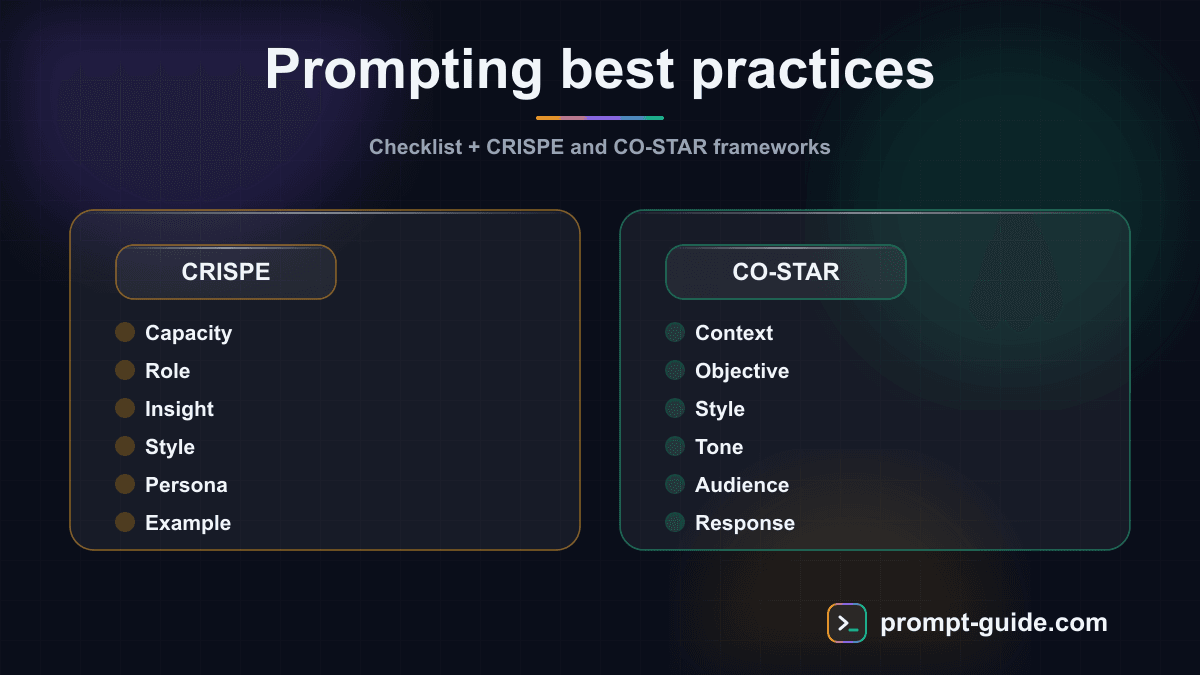
The CRISPE framework
The CRISPE framework is one of the most popular for structuring a complete prompt:
- C — Capacity: define the AI's role or expertise.
- R — Role: specify the role context.
- I — Insight: provide key information and context.
- S — Statement: clearly state the task.
- P — Personality: define the tone and style.
- E — Experiment: request variations or alternatives.
The CO-STAR framework
The CO-STAR framework, developed by the Singapore prompt engineering community, offers a complementary approach:
- C — Context: the situation context.
- O — Objective: the specific goal.
- S — Style: the desired style.
- T — Tone: the response tone.
- A — Audience: the target audience.
- R — Response: the expected response format.
No framework is universally superior. Use CRISPE for creative tasks and complex roles, CO-STAR for results-oriented professional tasks.
Iterating and refining your prompts
The iterative approach
Prompting is an iterative process, not a one-time act. The best prompters almost never find the perfect prompt on the first try. They follow a cycle of continuous improvement:
Draft an initial prompt
based on your intuition and the frameworks above.
Analyze the result
identifying what is missing, superfluous, or incorrect.
Modify the prompt
adjusting one element at a time.
Test again
and compare with the previous result.
Repeat
until satisfied.
The single-change rule
A common pitfall is modifying multiple elements simultaneously. Adopt the single-change rule: modify one aspect at a time and evaluate the impact before moving to the next.
Providing context: the key to effective prompts
Context is probably the most underestimated element of prompting. The AI only has access to information you provide in the prompt — it cannot guess your situation, specific needs, or implicit constraints.
Types of context to provide
- Situational context: who you are, your situation, why you are asking.
- Technical context: tools, technologies, or methodologies involved.
- Audience context: who the result is for, their knowledge level.
- Quality context: your quality standards, examples of good results.
- Constraint context: time, budget, resource, or format limitations.
Without context: "Write a follow-up email."
With context: "I'm a B2B SaaS salesperson. My prospect (CTO of a 500-person company) attended a demo 2 weeks ago but hasn't responded. Write a short follow-up email (max 150 words), professional but warm, suggesting a 15-minute call. Don't be pushy."
Defining constraints: guiding without restricting
Constraints are guardrails that channel the AI's creativity in the desired direction. Effective constraint types include:
- Length constraints: "In 200 words maximum", "In 3 paragraphs".
- Format constraints: "As a table", "In bullet points", "In JSON format".
- Tone constraints: "Professional tone", "Conversational tone".
- Content constraints: "No technical jargon", "With concrete examples".
- Negative constraints: "Don't mention X", "Avoid clichés".
Find the right balance: too many constraints can stifle response quality. Prioritize the most important constraints and leave flexibility on secondary aspects.
Managing output format
Output format determines the usability of the result. Advanced formatting techniques include requesting structured formats (JSON, Markdown, CSV), providing templates, using delimiters, and requesting metadata such as confidence levels or sources.
Testing and evaluating your prompts
A prompt is only truly good if it produces consistent results across multiple executions and with different inputs. Evaluate prompts on relevance, accuracy, completeness, format compliance, consistency, and usability. For critical prompts, adopt an A/B approach: test two variants on the same set of inputs and keep the best performer.
The perfect prompt checklist
- Clear objective: is the task unambiguously stated?
- Sufficient context: have you provided all relevant information?
- Defined role: have you specified the expected expertise?
- Explicit constraints: have you defined limits (length, format, tone)?
- Output format: have you specified how you want the response?
- Examples: have you provided examples for complex tasks?
- Audience identified: have you specified who the content is for?
- Quality criteria: have you indicated your quality standards?
- Edge cases: have you considered edge cases?
- Mental test: would another human understand exactly what you want?
Related Prompts
Write a Complete SEO Blog Article
Creates a complete, structured blog article optimized for search engines with all necessary tags and sections.
Design High-Converting Landing Page Copy
This prompt generates complete landing page copy structured according to CRO best practices, from the headline to the final CTA, covering every stage of persuasion.
Create an Editorial Style Guide for a Brand
This prompt produces an operational editorial style guide that ensures consistent brand voice across all channels, even with multiple writers.
Complete Code Review for Pull Requests
Get an exhaustive code review covering quality, performance, security, and maintainability for any language.
Create a Detailed and Structured Blog Post Outline
Create detailed blog post outlines with SEO structure, preliminary research, and supplementary elements.
Executive Summary of a Long Document
Transforms a long document into a structured executive summary with conclusions, attention points, and actionable recommendations for decision-makers.
Practice Exercises
Clarity and Precision
Learn to write clear and precise prompts to get exactly what you want.
Providing Context
Master the art of giving the right context to AI for relevant results.
Defining Output Format
Learn to specify the exact format of the expected response.
Setting Constraints
Discover how precise constraints drastically improve results.
Role Prompting
Use role assignment to get expert-level responses.
Few-shot Prompting
Teach by example: guide the AI with concrete examples.
Related guides
Continue your learning
You've finished this guide. Here's how to go further.
Practice what you learned
Interactive exercises to sharpen your prompting skills
Get new guides every week
Join our newsletter and never miss new content.