Short Prompt vs Detailed Prompt: When to Use Which?
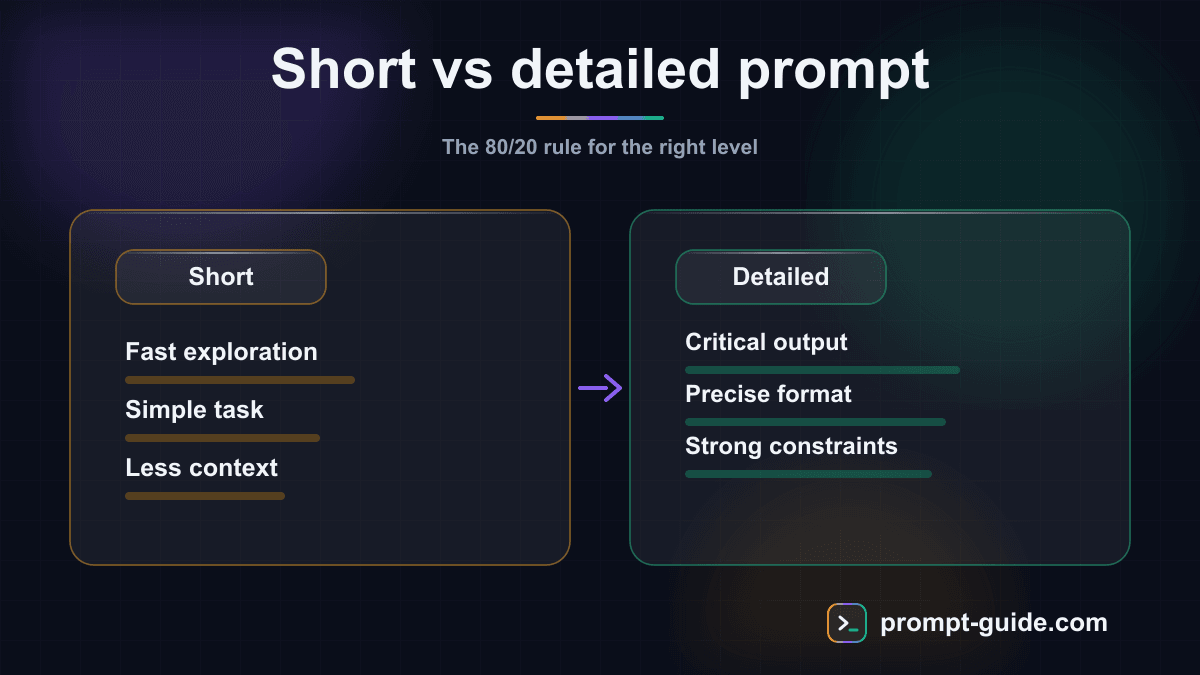
The false dichotomy: short or detailed?
One of the most frequent questions among generative AI users seems simple: should you write short or detailed prompts? The answer, as often in prompting, is nuanced. It is not about picking a side, but understanding when each approach is most effective.
The myth of the "perfect prompt" pushes many beginners toward two extremes. Some believe a single-line prompt always suffices because "the AI is smart." Others think you must systematically write entire paragraphs to get a good result. Both approaches are incorrect when applied blindly.
The optimal length of a prompt depends on several factors:
- Task complexity: a simple translation does not require the same level of detail as a complete business plan
- Subject ambiguity: the more ambiguous the topic, the more context is needed
- Expected format: if you have specific format requirements, they need to be specified
- Level of customization: generic content requires less context than tailored content
- Your knowledge of the model: the better you understand how the AI interprets your instructions, the more concise you can be
Golden rule: A good prompt contains exactly what the AI needs to produce the desired result — nothing more, nothing less. Every added word should bring value.
When a short prompt is enough: concrete examples
A short prompt (1 to 3 sentences) is perfectly suited for many situations. Here are the cases where brevity is your best ally.
1. Well-defined, unambiguous tasks
When the task is clear and leaves no room for interpretation, a short prompt works perfectly. The AI knows exactly what you expect without additional context.
- "Translate to French: The cat is on the mat."
- "Fix the spelling mistakes in this text: [text]"
- "Summarize this paragraph in one sentence: [paragraph]"
- "Give me 5 synonyms for the word 'quick'."
2. Simple factual questions
For general knowledge questions, a short prompt is not only sufficient but often preferable. Adding unnecessary context can even degrade response quality by "distracting" the model.
3. Initial brainstorming
When you are in an exploratory phase and looking for ideas without specific constraints, a short prompt gives the model more creative freedom.
4. Simple transformation operations
Reformatting, converting, extracting — these mechanical operations do not require elaborate instructions.
When a detailed prompt is necessary: concrete examples
A detailed prompt (5+ sentences, sometimes multiple paragraphs) becomes essential when the task involves subjectivity, complexity, or specific requirements.
1. Professional content writing
Writing a blog post, a commercial email, or a sales page requires numerous contextual pieces of information that the AI cannot guess. A short prompt like "Write an article about digital marketing" will produce generic content. A detailed prompt specifying the target audience, tone, length, structure, and examples will produce targeted, publish-ready content.
2. Complex analysis
When you ask the AI to analyze a situation, compare options, or formulate recommendations, context is crucial. Include the business context, evaluation criteria, and the expected conclusion format.
3. Specific code generation
Include the programming language and framework versions, project context, existing dependencies, edge cases to handle, expected code style, and desired unit tests.
4. Creative content with constraints
Free creative writing can work with a short prompt, but as soon as you have constraints (tone, style, length, audience), detail is necessary.
The 80/20 rule of prompting
In prompting as in productivity, the Pareto principle applies: 80% of your result quality depends on 20% of your instructions. The challenge is identifying those critical 20%.
The 20% that matters most
Clear task
(what exactly do you want?) — Impact: very high
Output format
(how do you want the result?) — Impact: high
Essential context
(for whom? in what setting?) — Impact: high
An example
(show what you expect) — Impact: medium to high
Tone and style
— Impact: medium
Negative constraints
(what NOT to do) — Impact: medium
If you can only include a few elements, focus on the first three. They represent the famous 20% that makes 80% of the difference.
Side-by-side comparisons: same task, short vs detailed
Nothing beats concrete examples. Here are comparisons of the same task treated with a short prompt then a detailed prompt.
Professional email
Short: "Write a follow-up email for a client."
Detailed: "Write a follow-up email for a B2B client (marketing director of a 200-person company) who hasn't responded to our proposal sent 10 days ago. Our offer was an SEO audit at $5,000. Professional and courteous tone. Propose an alternative (15-min call or new presentation slot). Maximum 150 words."
The detailed version produces a targeted email with the right tone, length, and relevant call-to-action.
Translation
Short: "Translate to English: [text]"
Detailed: "Translate this French marketing text to American English. Target audience: SaaS professionals in the US. Adapt idiomatic expressions rather than translating literally. Keep a dynamic, direct tone (American style, not British). Technical SaaS terms should remain in standard English (ARR, churn, etc.)."
Short is fine for basic translation. Detailed is necessary for professional localization.
How to find the right length for your prompt
The 3-question test
Ambiguity:
If I gave this instruction to 10 different people, would I get similar or very different results?
Stakes:
What are the consequences of a mediocre result?
Iteration:
Do I have the time and willingness for multiple back-and-forths?
Similar results + low stakes + time to iterate = short prompt. Very different results + high stakes + no time to iterate = detailed prompt.
Warning signs your prompt is too short
- You systematically need to follow up to get what you want
- The result is "correct but not what I wanted"
- The AI asks clarification questions
- You spend more time modifying the result than writing the prompt
Warning signs your prompt is too long
- You repeat the same instruction in different ways
- You include context that does not change the result
- The AI ignores some of your instructions (cognitive overload)
- Your constraints contradict each other
Progressive prompting: the optimal strategy
The best approach is neither short nor detailed from the start. It is progressive prompting: start short, then iterate by adding detail where needed.
The 4-step method
Step 1: Write the shortest possible version of your request. Include only the task and subject.
Step 2: Evaluate the result. Ask yourself: "What is missing or incorrect?"
Step 3: Reformulate your prompt by adding only the elements the AI did not guess correctly.
Step 4: Refine if necessary. Repeat steps 2-3 until you get a satisfactory result.
Building your prompt library
Progressive prompting has a valuable secondary benefit: it helps you build a library of optimized prompts for your recurring tasks. After a few iterations, you know exactly the level of detail needed for each type of task.
Actionable summary: Always start with a short prompt. If the result is not satisfactory, identify what is missing and add it. After a few iterations, you will have an optimized prompt you can reuse. This is faster and more effective than trying to anticipate everything from the start.
Related Prompts
Rephrase Text for Greater Clarity and Readability
Rephrase your texts to make them clearer, smoother, and more accessible without losing the original meaning.
Create a complete and effective FAQ
Create a complete and structured FAQ that reduces support requests with clear answers, a decision tree, and SEO optimization.
Design High-Converting Landing Page Copy
This prompt generates complete landing page copy structured according to CRO best practices, from the headline to the final CTA, covering every stage of persuasion.
Explain Complex Terms or Concepts Simply
Simplify any complex concept into clear, progressive, and memorable explanations.
Write a Complete SEO Blog Article
Creates a complete, structured blog article optimized for search engines with all necessary tags and sections.
Executive Summary of a Long Document
Transforms a long document into a structured executive summary with conclusions, attention points, and actionable recommendations for decision-makers.
Practice Exercises
Clarity and Precision
Learn to write clear and precise prompts to get exactly what you want.
Providing Context
Master the art of giving the right context to AI for relevant results.
Defining Output Format
Learn to specify the exact format of the expected response.
Setting Constraints
Discover how precise constraints drastically improve results.
Related guides
Continue your learning
You've finished this guide. Here's how to go further.
Practice what you learned
Interactive exercises to sharpen your prompting skills
Get new guides every week
Join our newsletter and never miss new content.