What is Prompting? The Complete Guide to Understanding and Mastering the Art of Communicating with AI
Prompting has become an essential skill in the age of artificial intelligence. Whether you use ChatGPT, Claude, Gemini, or any other language model, the quality of your results depends directly on how you phrase your requests. In this comprehensive guide, we will explore in depth what prompting is, why it is so important, and how you can master it to get the most out of AI in your daily life.
The Future of Prompting in 2025 and Beyond
Prompting is evolving rapidly with advances in language models. Interfaces are becoming more intuitive, models better understand intentions, and new modalities (image, audio, video) are expanding possibilities. However, the ability to formulate clear and structured instructions will remain a fundamental skill. Tomorrow's prompts will likely be more conversational, multi-step, and multimodal, but the core principles — clarity, context, structure, and iteration — will remain at the heart of every successful interaction with AI. Investing in learning prompting today means preparing for the jobs of tomorrow, where AI will be a daily work partner.
How to Get Started with Prompting: A Step-by-Step Guide
Convinced of the importance of prompting and ready to get started? Here is a structured path to help you progress quickly, whether you're starting from scratch or looking to refine your skills.
Choose Your AI Tool
Start with a free model like ChatGPT (free version), Claude (Anthropic), or Gemini (Google). Each has its own characteristics, but the principles of prompting are the same. The important thing is to start practicing right away.
Learn the Basics
Master the fundamental concepts: role, context, constraints, output format. Our free training covers all these elements with hands-on interactive exercises.
Practice with Structured Exercises
Use our interactive exercises organized by difficulty level. Start with beginner-level exercises to build your confidence, then progress to more complex scenarios.
Use Templates as a Starting Point
Explore our library of ready-to-use templates. Analyze their structure, understand why they are effective, then adapt them to your specific needs.
Iterate and Experiment
Prompting is a skill that improves with practice. Test different approaches, compare results, and gradually build your own collection of effective prompts.
Explore Advanced Techniques
Once you have mastered the basics, discover advanced techniques like chain-of-thought, tree-of-thought, self-consistency, and few-shot learning to push the boundaries of what you can achieve.
The 6 Components of a Good Prompt
An effective prompt is made up of several key elements that, when combined, maximize the quality of the response. Here are the six fundamental components to master for writing high-performing prompts.
Context
Provide the necessary background information. Who are you? What is the project? Who is the target audience? The richer and more relevant the context, the better the response will be tailored to your actual situation. For example, instead of saying 'write an email,' specify 'write a professional email for a B2B client in the banking sector.'
Clear Instruction
State precisely what you expect. Use specific action verbs like 'analyze,' 'compare,' 'summarize,' 'write,' 'propose' rather than vague terms like 'tell me about.' A clear instruction eliminates ambiguity and guides the AI toward the exact result you are looking for.
Output Format
Specify how the response should be structured: bullet points, table, paragraphs, code, JSON, Markdown... Defining the format avoids surprises and allows you to integrate the result directly into your workflow without additional reformatting.
Constraints
Define the boundaries: maximum length, tone (formal, casual, technical), what should be included or excluded, the desired level of detail. Constraints channel the AI's creativity and ensure the result meets your specific requirements.
Examples
Provide one or more examples of the expected result. Examples are the most effective way to communicate exactly what you want, especially for creative tasks or specific formats. A single good example is often worth more than ten lines of instructions.
Personalization
Adapt the prompt to your unique use case. Include variables, specific references to your domain, and personal preferences. Personalization transforms a generic prompt into a custom tool that produces directly usable results.
Definition of Prompting: What Exactly Is It?
Prompting (or prompt engineering) refers to the art and science of crafting precise and effective instructions to communicate with an artificial intelligence model. A prompt is the request, instruction, or message you send to a generative AI to obtain a response. The term comes from the English verb 'to prompt,' meaning 'to incite' or 'to elicit.' In other words, a prompt is the stimulus that triggers the AI to generate a response. But prompting goes far beyond a simple question: it is a true language of communication between humans and machines, requiring an understanding of how language models interpret and process information.
The Most Common Prompting Mistakes
Even experienced users sometimes make these mistakes. Knowing them will help you avoid them and immediately improve the quality of your results.
- Being too vague: 'Help me with my project' does not provide enough context. Always specify the subject, objective, and constraints.
- Overloading the prompt: a 2,000-word prompt with dozens of contradictory constraints will confuse the AI. Find the balance between precision and clarity.
- Forgetting the output format: without specifying the format, the AI chooses on its own and the result often does not match your expectations.
- Not iterating: accepting the first response without refining it. Prompting is an iterative process — don't hesitate to ask for adjustments.
- Ignoring conversation context: in a long conversation, the AI can lose track. Regularly remind it of key elements.
- Not fact-checking: language models can generate incorrect information (hallucinations). Always verify critical data.
- Copy-pasting prompts without adapting them: a prompt that works for someone else won't necessarily work for you without adapting it to your specific context.
Concrete Examples: Before/After a Good Prompt
Let's look at the difference between a basic prompt and an optimized prompt across several common use cases. These examples concretely illustrate how applying prompting principles can transform the quality of the results you get.
- Example 1: Email Writing — Bad prompt: 'Write an email for my client.' — Good prompt: 'Write a professional follow-up email for a B2B client in the logistics sector. Tone: courteous but assertive. Objective: follow up on a commercial proposal sent 10 days ago with no response. Length: 150 words maximum. Include a clear CTA to schedule a call this week.'
- Example 2: Data Analysis — Bad prompt: 'Analyze these numbers.' — Good prompt: 'You are a senior financial analyst. Analyze the Q3 2025 sales data below. Identify the 3 main trends, any anomalies, and formulate 2 actionable recommendations for Q4. Present the results in a summary table followed by a 200-word synthesis.'
- Example 3: Content Creation — Bad prompt: 'Write an article about AI.' — Good prompt: 'Write a 1,500-word blog article about the impact of generative AI in the education sector in France. Target audience: secondary school teachers. Structure: engaging introduction, 4 sub-sections with concrete examples of tools usable in the classroom, conclusion with 3 key takeaways. Tone: educational and enthusiastic, no technical jargon.'
- Example 4: Code Prompt — Bad prompt: 'Make me a sorting function.' — Good prompt: 'Write a TypeScript function that sorts an array of objects {name: string, date: Date, priority: number} by priority (descending) then by date (ascending). Include generic types, edge cases (empty array, null values), and a JSDoc comment. Add 3 unit tests with Vitest.'
The Most Popular Prompting Frameworks
Several frameworks have been developed to structure your prompts systematically. These methods provide a reproducible framework for creating effective prompts, whether you are a beginner or advanced user.
- RACE (Role, Action, Context, Expectations) — Define the AI's role, the action to perform, the context of the request, and the expectations in terms of results. A simple and universal framework, ideal for beginners.
- CO-STAR (Context, Objective, Style, Tone, Audience, Response) — A more comprehensive framework that adds dimensions of style, tone, and audience. Particularly suited for content creation and communication tasks.
- RODES (Role, Objective, Details, Examples, Sense-check) — Integrates a final verification step where the AI validates its own response. Useful for critical tasks where precision is essential.
- APE (Action, Purpose, Expectation) — A minimalist framework for quick prompts. Define the action, the purpose, and what you expect. Perfect for daily interactions with AI.
The History of Prompting: From Origins to Today
The concept of prompting has evolved considerably since the first natural language processing models. Before 2020, interactions with AI systems were limited to rigid commands and predefined interfaces. The arrival of GPT-3 in 2020 marked a major turning point: for the first time, a language model could understand and respond to instructions in natural language. Since then, the field has experienced a meteoric acceleration with the launch of ChatGPT in late 2022, followed by Anthropic's Claude, Google's Gemini, and a multitude of other models. Prompting has gone from a technical curiosity to a sought-after professional skill, with the emergence of the 'prompt engineer' role and dedicated training programs in companies worldwide.
Prompting Tools and Resources
The prompting ecosystem offers numerous tools to help you progress and optimize your interactions with AI. Here are the essential resources to know.
- ChatGPT (OpenAI): the most popular model, available in a free version. Ideal for getting started and for everyday use. The Plus version offers access to GPT-4 and plugins.
- Claude (Anthropic): excellent for long texts (up to 200K tokens of context), document analysis, and tasks requiring fine comprehension. Artifacts and Projects features.
- Gemini (Google): strong in multimodal analysis (text, images, video) and natively integrated with the Google Workspace ecosystem. Ideal for users of Google Docs, Sheets, and Slides.
- The Art of Prompting Prompt Builder: our free interactive tool to create and optimize your prompts step by step, with real-time suggestions and tailored templates.
- Interactive Exercises: our platform offers dozens of progressive exercises to practice prompting in real-world conditions, with immediate correction and feedback.
- Prompting Glossary: all technical terms explained simply so you never feel lost with generative AI jargon.
Why Is Prompting So Important?
The quality of a prompt directly determines the quality of the response obtained. The same AI model can produce mediocre or exceptional results depending on how the request is formulated. This is called the 'prompt gap': the difference between what the AI can theoretically do and what it actually produces based on the instructions received.
- Multiplied productivity: a good prompt can reduce the time spent on certain creative and analytical tasks by 80%, by getting the right result on the first try
- Quality of results: precise instructions generate more relevant, better-structured responses that are more suited to your real needs
- Token and cost savings: well-crafted prompts avoid unnecessary back-and-forth and reduce API consumption, which represents significant savings at scale
- Competitive advantage: in a world where everyone has access to the same AI tools, the difference lies in the ability to use them effectively
- Reproducibility: a well-designed prompt can be reused, shared, and improved over time, creating a valuable knowledge base for your team
- Augmented creativity: prompting allows you to explore new angles and generate ideas you might not have had on your own, by pushing the AI in specific directions
The Different Types of Prompts
There are several categories of prompts, each suited to different situations and objectives. Understanding these types allows you to choose the right approach for each situation and optimize your results.
- Zero-shot Prompt — The simplest type: you give a direct instruction without providing any example. The AI relies solely on its pre-existing knowledge. Ideal for simple, well-defined tasks. Example: 'Translate this text into English.'
- Few-shot Prompt — You provide one or more examples before your actual request. The AI uses these examples to understand the expected format, tone, and style. Very effective for classification, rephrasing, or generation tasks with a specific format.
- Chain of Thought (CoT) — You explicitly ask the AI to reason step by step before giving its final answer. This technique significantly improves performance on complex, mathematical, or logical problems. Example: 'Think step by step...'
- Role Prompt — You assign a specific role or expertise to the AI before asking your question. For example: 'You are an SEO expert with 15 years of experience.' This technique steers responses toward an appropriate level of detail and vocabulary.
- System Prompt — High-level instructions that define the AI's overall behavior for the entire conversation. Used to set the context, constraints, and rules to follow. It is the foundation upon which all subsequent exchanges rest.
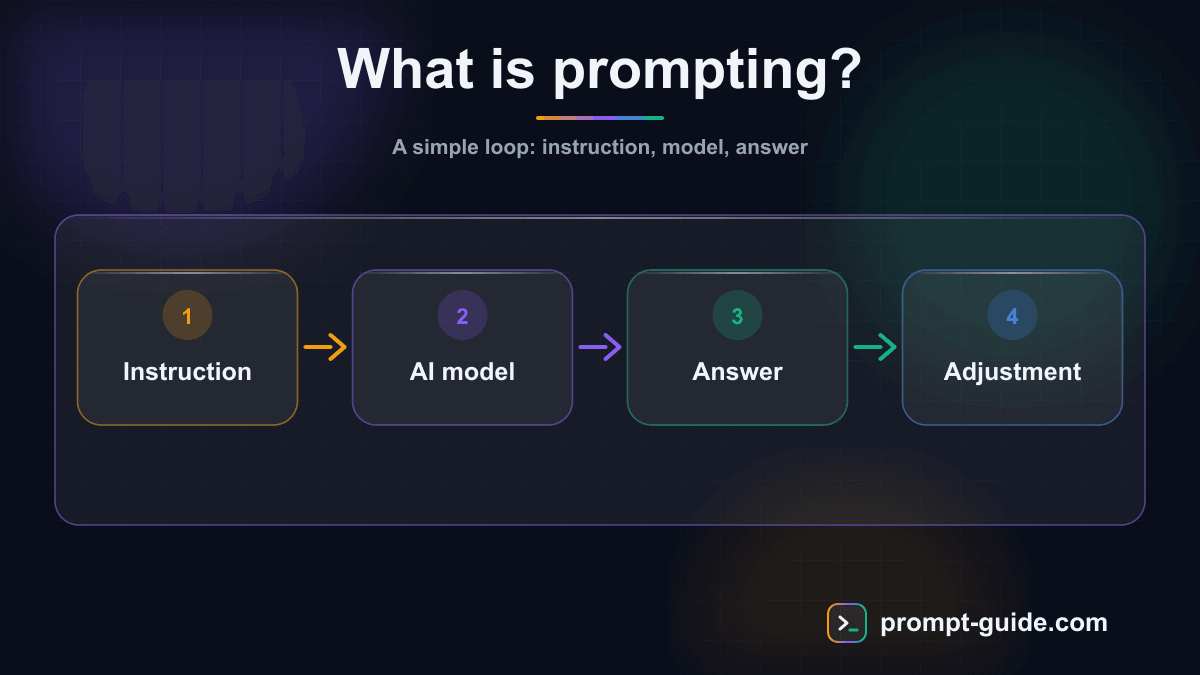
- Iterative Prompt — A series of prompts that build on each other to progressively refine the result. Each new prompt builds on the previous response to correct, enrich, or clarify. Ideal for complex projects like writing an article or creating a marketing plan.
Conclusion
Prompting is much more than a simple technique: it is a new form of communication that is transforming our relationship with technology. Whether you are a student, professional, entrepreneur, or simply curious, mastering prompting will open up infinite possibilities. Start now with our hands-on exercises and our interactive prompt builder, and discover how AI can become your best daily ally.
Related Prompts
Create a complete and effective FAQ
Create a complete and structured FAQ that reduces support requests with clear answers, a decision tree, and SEO optimization.
Rephrase Text for Greater Clarity and Readability
Rephrase your texts to make them clearer, smoother, and more accessible without losing the original meaning.
Executive Summary of a Long Document
Transforms a long document into a structured executive summary with conclusions, attention points, and actionable recommendations for decision-makers.
Explain Complex Terms or Concepts Simply
Simplify any complex concept into clear, progressive, and memorable explanations.
Write a High-Impact B2B Prospecting Email
This prompt generates short, personalized, results-oriented B2B prospecting emails with an optimized response rate thanks to a proven structure.
Practice Exercises
Clarity and Precision
Learn to write clear and precise prompts to get exactly what you want.
Providing Context
Master the art of giving the right context to AI for relevant results.
Defining Output Format
Learn to specify the exact format of the expected response.
Related guides
Continue your learning
You've finished this guide. Here's how to go further.
Practice what you learned
Interactive exercises to sharpen your prompting skills
Get new guides every week
Join our newsletter and never miss new content.