You've opened ChatGPT, but you don't know what to ask — or your prompts are giving disappointing results? You're not alone. Most users underutilize the tool due to lack of inspiration or method.
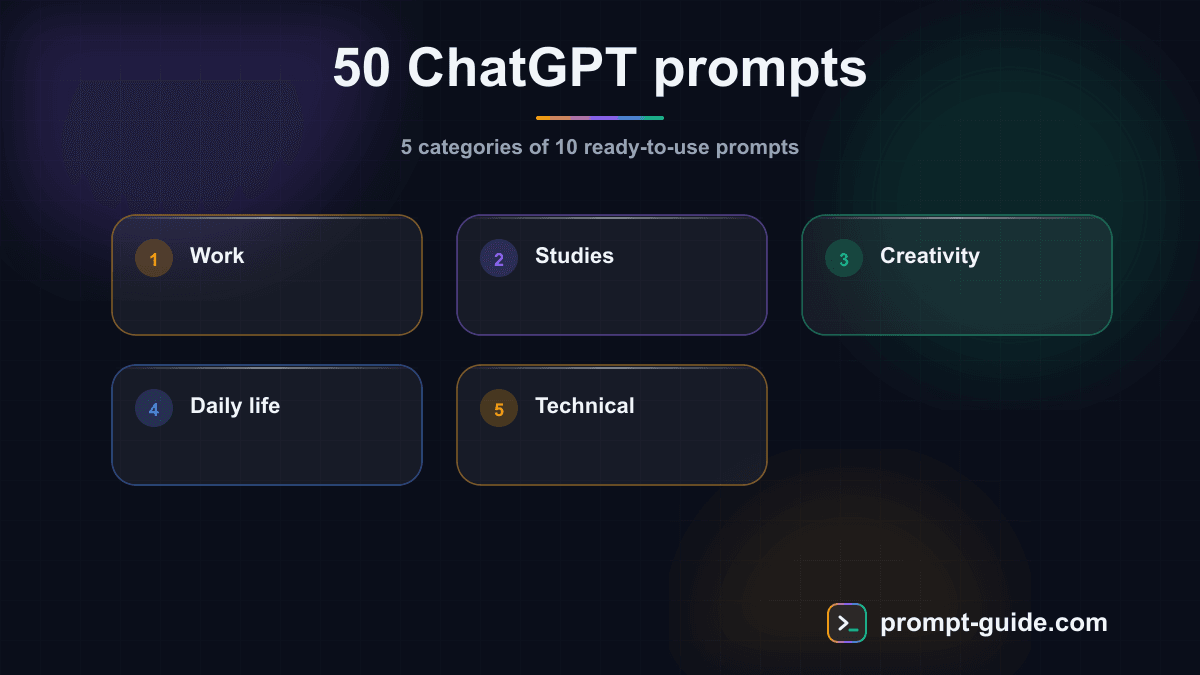
This article solves that problem: here are 50 tested and optimized ChatGPT prompts, organized into 5 practical categories. Each prompt is ready to copy-paste, accompanied by its usage context and the result you can expect. Customize the parts in [brackets] to adapt them to your situation.
To understand why these prompts work, check out our guide on how to write a great ChatGPT prompt.
Category 1: Work and productivity (prompts 1-10)
These prompts cover the most common professional tasks: emails, meetings, presentations, project management, and decision-making.
1. Write a client follow-up email
Context: You sent a quote and haven't received a response.
You are an experienced sales professional. Write a follow-up email for a client who hasn't responded to my quote sent [10 days] ago. The quote is for [service/product]. The tone should be polite but assertive, with a call-to-action to schedule a call this week. Maximum 120 words. Also suggest a catchy subject line.
Expected result: A professional email with subject line, body, and CTA — ready to send.
2. Prepare a meeting agenda
Context: You're organizing a team meeting and want a structured agenda.
You are a project manager. Create a structured agenda for a [60-minute] meeting on the topic [quarterly review]. Participants: [marketing team, 6 people]. Include: meeting objective, discussion points with estimated duration, person responsible for each point, and 5 minutes for questions/action items at the end. Table format.
Expected result: A table with columns for Time, Topic, Duration, and Owner.
3. Summarize meeting notes
Context: You have disorganized meeting notes.
Summarize these meeting notes into a professional structured report: (1) participants, (2) decisions made, (3) action items with owner and deadline, (4) next steps. Be concise — maximum 300 words. Here are the notes: [paste your notes]
Expected result: A clear, actionable meeting report ready to share via email.
4. Write a job description
Context: You're hiring and need an attractive job posting.
You are an HR manager. Write an attractive job description for a [junior fullstack developer]. The company: [20-person SaaS startup, New York, hybrid]. Include: company overview (3 lines), key responsibilities (5-6 points), required profile (technical and soft skills), and benefits. Tone: professional but relaxed.
Expected result: A job posting ready to publish on job boards.
5. Create a structured PowerPoint presentation
Context: You need to present results to your leadership team.
You are a presentation consultant. Create a detailed plan for a [15-slide] presentation on [Q1 2026 marketing results]. Audience: [executive team]. For each slide, indicate: the title, the key message (1 sentence), the recommended visual type (chart, table, image, text), and the data to include. The presentation should tell a story: problem → actions → results → next steps.
Expected result: A slide-by-slide plan with clear narrative.
6. Analyze a project's strengths and weaknesses
Context: You want a quick SWOT analysis.
Perform a complete SWOT analysis for [launching an online course on prompting]. Context: [English-speaking market, targeting professionals aged 25-45, priced at $197, launching in 2 months]. Present Strengths, Weaknesses, Opportunities, and Threats in a table with 4-5 points per category. Add a strategic recommendation in the conclusion.
Expected result: A SWOT table + actionable strategic recommendation.
7. Write a creative brief
Context: You need to brief a designer or freelancer.
You are a creative director. Write a complete creative brief for [creating a landing page]. The project: [promoting a free ebook on prompting]. Target: [professionals aged 30-50]. Include: objective, key message, desired tone and style, visual references for inspiration, required elements (logo, CTA, form), technical constraints, and deadline.
Expected result: A structured brief ready to send to the contractor.
8. Negotiate a salary via email
Context: You received a job offer below your expectations.
You are a salary negotiation coach. Write an email to negotiate a higher offer. I received an offer at [$90K] for a [digital project manager] position. My experience: [5 years]. The market rate for this role is [$95K-$110K]. The tone should be grateful, professional, and assertive. Highlight my value without being arrogant. Maximum 200 words.
Expected result: An elegant, persuasive counter-offer email.
9. Create a weekly reporting template
Context: You need to send a report to your manager every week.
Create a weekly reporting template for a [digital marketing manager]. The template should include: top 3 achievements of the week, key KPIs with trends (table format), problems encountered and solutions, next week's priorities, requests for help/decisions needed. Everything should fit on one page maximum. Professional format with subtle emojis for readability.
Expected result: A reusable weekly template, ready to copy-paste into an email.
10. Make a tough decision
Context: You're torn between two professional options.
You are a decision-making coach. I'm torn between [staying at my current job with a 10% raise] and [accepting a new position at a startup with 20% more pay but more risk]. Help me decide using a decision matrix with criteria: financial security, career growth, work-life balance, learning opportunities, alignment with my values. Score each option 1-5 per criterion. Conclude with an argued recommendation.
Expected result: A scored decision matrix + recommendation.
Category 2: Studies and learning (prompts 11-20)
Prompts for students, learners, and the curious: revision, comprehension, academic writing, and exam preparation.
11. Explain a complex concept simply
Context: You're studying a difficult topic and need a clear explanation.
Explain [the theory of special relativity] to me as if I were 15 years old. Use an everyday analogy, a simple mental model, and a concrete example. End with 3 questions I can ask myself to check if I understood. Maximum 250 words.
Expected result: An accessible explanation with analogy and self-assessment.
12. Create revision flashcards
Context: You're studying for an exam.
You are a teacher specializing in pedagogy. Create 10 revision flashcards on [the French Revolution]. Each card contains: a title, 3-4 essential points to remember, a key date or figure, and a self-assessment question with answer. Compact format — each card is 5 lines maximum.
Expected result: 10 concise flashcards ready to print or review on mobile.
13. Generate a practice quiz
Context: You want to test yourself on a subject.
Generate a 15-question quiz on [digital marketing: SEO, PPC, social media]. Difficulty: [intermediate]. For each question: 4 answer choices (A, B, C, D), one correct answer, and a short explanation of the right answer. Mix the topics to test overall understanding.
Expected result: A complete quiz with answers and explanations.
14. Summarize a book chapter
Context: You're reading a dense book and want to extract the essentials.
Summarize the main concept of [chapter/topic] following this structure: (1) Central idea in 1 sentence, (2) The author's 3 main arguments, (3) A concrete example from the text, (4) How to apply these ideas in [my field]. Maximum 200 words. Here's the text: [paste the text]
Expected result: An actionable summary that goes beyond a simple factual recap.
15. Write an essay introduction
Context: You need to write an academic essay.
You are a [philosophy] professor. Write an essay introduction on the topic: "[Does technological progress make us more free?]". The introduction should contain: a hook (fact, quote, or paradox), the clearly stated problem, and the outline announcement in 3 parts. Academic style, 150-200 words. Don't write the body.
Expected result: A structured introduction ready to serve as a base for the essay.
16. Create a personalized study plan
Context: You want to learn a new skill in a structured way.
You are a learning coach. I want to learn [Python for data analysis] from scratch. I have [5 hours per week] to dedicate over [3 months]. Create a week-by-week study plan with: topics to cover, recommended free resources, a practical mini-project per week, and milestones to measure my progress.
Expected result: A 12-week learning plan with resources and projects.
17. Proofread and improve an academic text
Context: You've written a paper and want to improve it.
You are a demanding university professor. Proofread and improve this academic text by addressing: (1) grammar and spelling errors, (2) clarity of argumentation, (3) quality of transitions, (4) precision of vocabulary. Present the improved text, then list the 5 major improvements with explanations. Here's the text: [paste your text]
Expected result: An improved text + detailed constructive feedback.
18. Prepare an oral presentation
Context: You need to present a topic to your class or colleagues.
Help me prepare a [10-minute] presentation on [the impact of AI on education]. Structure: introduction with a punchy hook, 3 balanced sections with concrete examples, conclusion with an opening. For each section, write the key talking points (not a word-for-word script) and suggest a visual or a question to ask the audience.
Expected result: A presentation outline with speaking notes and public engagement tips.
19. Turn notes into a mind map
Context: You have scattered notes and want to organize them visually.
Organize these notes into a text-based mind map. Identify the central theme, main branches (4-6 maximum), sub-branches for each branch, and connections between ideas. Use indented hierarchy to represent the mind map. Here are my notes: [paste your notes]
Expected result: A clear hierarchical structure that visually organizes ideas.
20. Simulate an oral exam
Context: You're preparing for an oral exam and want to practice.
You are a rigorous but supportive examiner for [an English literature oral exam]. Ask me a question about [Shakespeare's Hamlet]. After my response, evaluate it out of 20 indicating: strong points, areas for improvement, and a more effective phrasing suggestion. Start with the first question.
Expected result: An interactive training session with personalized feedback.
Category 3: Creativity and content (prompts 21-30)
Prompts for creative writing, social media, storytelling, and content creation in all its forms.
21. Write an engaging LinkedIn post
Context: You want to publish professional content on LinkedIn.
You are a copywriter specializing in LinkedIn personal branding. Write a 200-word post on the topic: "[the biggest lesson I learned this year in management]". Start with a punchy hook (question or counter-intuitive statement). Structure in short paragraphs (1-2 sentences). End with an open question for engagement. Tone: authentic and conversational, not corporate.
Expected result: A LinkedIn post ready to publish with hook and CTA.
22. Generate a month's worth of content ideas
Context: You manage a blog or social media accounts and need inspiration.
You are a content strategist. Generate a 30-idea content calendar for [a personal development Instagram account]. For each idea, indicate: the format (carousel, reel, story, post), the specific topic, the hook, and the best posting day/time. Alternate content types: educational, inspirational, personal, interactive.
Expected result: A complete editorial calendar for 30 days.
23. Write a short story
Context: You want to write fiction or a narrative for a creative project.
You are a short story author. Write a 500-word short story in the [science fiction] genre. Theme: [a world where AIs have emotions]. Include a relatable main character, a central conflict, a plot twist, and an open ending. Style: polished prose, natural dialogue, fast pace.
Expected result: A complete short story with narrative structure and literary style.
24. Create hooks for a blog post
Context: You've written an article and are looking for the best hook.
Generate 10 different hooks for a blog post titled "[How to Double Your Productivity with AI]". Vary the approaches: question, shocking statistic, counter-intuitive statement, anecdote, result promise, painful problem. For each hook, indicate the technique used and why it works. Maximum 2 sentences per hook.
Expected result: 10 varied hooks with technique explanations.
25. Write an engaging newsletter
Context: You send a regular newsletter to your audience.
You are a successful newsletter writer. Write an edition on the topic: "[3 free AI tools I use every day]". Structure: subject line (targeting 40%+ open rate), preheader, personal introduction (2-3 sentences), the 3 tools with description + concrete use case each, conclusion with CTA. Tone: like an email to a knowledgeable friend. Maximum 500 words.
Expected result: A complete newsletter with subject line, body, and CTA.
26. Write a YouTube video script
Context: You create video content and need a script.
You are a YouTube video scriptwriter. Write the script for an [8-minute] video on "[5 Beginner Mistakes with ChatGPT]". Include: a hook in the first 10 seconds to prevent clicking away, the 5 mistakes with suggested visual examples, natural transitions between each point, and an end CTA (like, subscribe, comment). Indicate moments to insert B-roll or on-screen text.
Expected result: A complete script with editing cues.
27. Create a professional bio
Context: You need to write your bio for a website, social media, or conference.
Write 3 versions of my professional bio: (1) short version for Twitter/X (160 characters max), (2) medium version for LinkedIn (300 words), (3) long version for a website (150 words). My info: [position, company, career path, key achievements, passion]. The tone should be [professional but accessible]. Highlight [my specialty/value proposition].
Expected result: 3 bios adapted to different formats and platforms.
28. Find a name for a project
Context: You're launching a project and looking for the perfect name.
You are a naming and branding expert. Suggest 20 names for [a meditation mobile app for stressed professionals]. Criteria: easy to pronounce in English, memorable, logically available as .com, evokes [calm, performance, simplicity]. Group suggestions into 3 categories: descriptive names, evocative names, invented names. For your top 3 picks, explain why they work.
Expected result: 20 categorized names + rationale for the top 3.
29. Rephrase a text in a different tone
Context: You have a text you want to adapt for a different audience.
Rephrase this text in 3 different versions: (1) formal tone for a corporate report, (2) casual tone for a blog post, (3) enthusiastic tone for an Instagram post. Keep the same message and information, only change the style, vocabulary, and structure. Here's the text: [paste your text]
Expected result: 3 versions of the same text adapted to different contexts.
30. Write a compelling "About" page
Context: You're creating your website and need to write the most-read page after the homepage.
You are a copywriter specializing in "About" pages. Write a 400-word page for [my AI consulting business]. Narrative structure: start with the problem my clients face, tell my journey (from [software engineer] to [AI consultant]), explain my unique method, and end with a call-to-action. The reader should feel understood and confident. Integrate social proof if possible.
Expected result: An "About" page that tells a story and builds trust.
Category 4: Daily life (prompts 31-40)
Prompts for everyday life: travel, cooking, wellness, personal finance, and organization.
31. Plan a complete trip
Context: You're going on vacation and want an optimized itinerary.
You are an expert travel agent. Plan a [7-day] trip to [Lisbon, Portugal] for [a couple, moderate budget]. Include: day-by-day itinerary with morning/afternoon/evening activities, recommended restaurants (one per day), estimated daily budget, local transportation tips, and 3 hidden gems off the beaten path. Consider the [season: June] for suggestions.
Expected result: A complete day-by-day itinerary with budget and recommendations.
32. Create a weekly meal plan
Context: You want to eat healthy without the hassle.
You are a practical nutritionist. Create a 7-day menu (lunch + dinner) for [2 adults]. Constraints: [vegetarian, $65/week budget, max 30 min prep per meal]. Present as a table (Day | Lunch | Dinner). Add a shopping list organized by grocery store section at the end.
Expected result: A weekly menu + ready-to-use shopping list.
33. Write an effective complaint letter
Context: You have a dispute with a supplier or company.
You are a customer relations expert. Write a formal complaint letter for [a damaged package received from (company)]. Order number [XXX], received on [date]. Include: summary of facts, applicable consumer law references, specific request (refund/replacement), deadline given, and mention of further action if no response. Firm but polite tone.
Expected result: A formal, persuasive complaint letter ready to send.
34. Set up a monthly budget
Context: You want to take control of your finances.
You are a personal finance advisor. Help me create a monthly budget. My net income: [$4,500/month]. My fixed expenses: [rent $1,800, insurance $120, subscriptions $80, transportation $100]. Use the 50/30/20 method (needs/wants/savings). Present a table with all categories and allocated amounts. Identify areas where I can save and suggest 3 concrete actions to save an extra $200 per month.
Expected result: An allocated budget + 3 concrete savings actions.
35. Find a personalized gift
Context: You're looking for a gift idea for a specific occasion.
Suggest 10 gift ideas for [my mom's 60th birthday]. She likes: [gardening, reading, Italian cooking]. She doesn't like: [technology, gadgets]. Budget: [$30-80]. For each idea, give: the gift, why she'd love it, where to buy it, and a personal touch to add.
Expected result: 10 personalized ideas with rationale and tips.
36. Write a speech for an event
Context: You need to speak at a personal or professional event.
You are a speechwriter. Write a [3-minute] speech for [my best friend's wedding]. Tone: heartfelt with touches of humor. Include: a shared anecdote, what I admire about them, a message to the couple, and a conclusion with a toast. The style should be natural, not grandiose — as if I were really talking to my friend. My name: [X], theirs: [Y].
Expected result: An authentic, heartfelt 3-minute speech.
37. Create a fitness program
Context: You want to get (back) into shape with a structured plan.
You are a certified fitness coach. Create a [4-week] training program for [general fitness]. My profile: [male/female, 35 years old, sedentary for 1 year, no injuries]. Availability: [3 sessions of 45 minutes per week]. No gym — home exercises only. Present each session with: warm-up, exercises (sets x reps), recovery. Progression from one week to the next.
Expected result: A detailed 12-session program with progression.
38. Write a listing to sell an item
Context: You're selling on eBay, Facebook Marketplace, or another platform.
You are an online selling expert. Write an optimized listing to sell [a MacBook Air M2 2023 in excellent condition] on [Facebook Marketplace]. Include: a catchy title (max 50 characters), a complete description (condition, specs, included accessories, reason for selling), the recommended price based on the current market, and 3 tips for photos to take.
Expected result: An optimized listing ready to publish + photo tips.
39. Organize a move
Context: You're moving soon and want to plan everything.
You are an organization expert. Create a complete moving checklist for a [2-bedroom apartment]. Moving date: [in 6 weeks]. Organize by time period: 6 weeks before, 4 weeks before, 2 weeks before, 1 week before, moving day, after the move. Include administrative tasks (utilities, address change, insurance), packing/sorting, logistics, and estimated budget. Checkbox format.
Expected result: A chronological checklist with all steps covered.
40. Write a compelling cover letter
Context: You're applying for a job and want to stand out.
You are a recruitment consultant. Write a cover letter for a [communications manager] position at [Company X, tech sector]. My profile: [5 years of agency experience, specializing in digital strategy and PR]. The letter should: avoid cliche phrases ("dynamic," "motivated"), show knowledge of the company, highlight 2 concrete achievements with numbers, and end with a meeting request. Maximum 300 words.
Expected result: A compelling cover letter without cliches, backed by evidence and data.
Category 5: Technical and development (prompts 41-50)
Prompts for developers, data analysts, and technical profiles: code, debugging, architecture, and automation.
41. Debug code
Context: Your code isn't working and you can't find the bug.
You are a senior [JavaScript/TypeScript] developer. This code produces the following error: [paste the error]. Analyze the code, identify the cause of the bug, explain why it occurs, and propose the fix with modified code. If multiple causes are possible, list them by probability. Here's the code: [paste your code]
Expected result: Precise bug diagnosis + corrected code + explanation.
42. Write a complex SQL query
Context: You need to extract specific data from a database.
You are a data analyst who is an SQL expert. Write a SQL query to [extract the top 10 customers by revenue over the last 12 months, with their order count and average order value]. Available tables: [customers (id, name, email), orders (id, customer_id, amount, order_date), order_items (id, order_id, product_id, quantity, price)]. Add comments for each part of the query.
Expected result: An optimized, commented SQL query.
43. Design a REST API
Context: You're developing an API and want a solid starting point.
You are a backend architect. Design the endpoints for a REST API for [a task management system (to-do app)]. For each endpoint: HTTP method, URL, parameters, expected body (JSON), response (JSON with HTTP status codes), and a curl example. Include: full CRUD, filtering, pagination, and JWT authentication. Use standard REST conventions.
Expected result: Complete API endpoint documentation with examples.
44. Generate test data
Context: You need realistic data to test your application.
Generate a test dataset in JSON format: 20 users with realistic data. Each user has: id, first_name, last_name, email (consistent with the name), date_of_birth (varied ages 18-65), city (varied US cities), profession, signup_date (between 2024 and 2026). The data should be internally consistent — no "Pierre Dupont" with a New York address.
Expected result: A JSON file with 20 realistic, consistent users.
45. Explain existing code
Context: You've inherited code you don't understand.
You are a senior developer who's great at teaching. Explain this code line by line. For each logical section, explain: what it does, why it does it that way, and if there are possible improvements (performance, readability, security). Also indicate any external dependencies used. Here's the code: [paste your code]
Expected result: A detailed explanation with improvement suggestions.
46. Write unit tests
Context: You want to test a function or module.
You are a senior QA engineer. Write comprehensive unit tests for this function using [Jest/Vitest]. Cover the following cases: nominal case, edge cases (null values, empty, extremes), error cases, and invalid type cases. For each test, write a descriptive name that explains what's being tested. Aim for 100% coverage. Here's the function: [paste your code]
Expected result: A complete test suite with nominal and edge cases.
47. Create a regular expression
Context: You need to validate or extract data with a regex.
Create a regular expression (regex) to [validate a US phone number in all possible formats: (555) 123-4567, 555-123-4567, +1 555 123 4567, 15551234567]. Provide the regex, explain each part, show 5 examples that match and 5 that don't. Bonus: give the JavaScript and Python versions.
Expected result: A tested regex with positive and negative examples + explanation.
48. Optimize web page performance
Context: Your site is slow and you want to speed it up.
You are a web performance expert. Here are my page metrics: [LCP: 4.2s, FID: 180ms, CLS: 0.25, total weight: 3.8MB, 85 requests]. The page is a [Next.js e-commerce site]. Give me a prioritized optimization plan: the 10 actions to take ordered by impact, with each action's estimated improvement, difficulty level, and implementation steps.
Expected result: An optimization plan ordered by effort/impact ROI.
49. Write a professional README
Context: You're publishing an open source or internal project.
You are an experienced open source developer. Write a professional README.md for [my project: a Node.js CLI that generates secure passwords]. Include: version and license badges, 2-sentence description, screenshot or demo GIF (placeholder), installation (npm), usage with command examples, options/configuration, contributing guidelines, and license. Use GitHub markdown.
Expected result: A complete, professional, well-formatted README.
50. Design a database schema
Context: You're starting a new project and need to structure your data.
You are a database architect. Design the database schema for [a medical practice management application]. Required entities: patients, doctors, appointments, prescriptions, payments. For each table: name, columns with types, primary and foreign keys, recommended indexes, and constraints. Present as pseudo-SQL CREATE TABLE statements. Add a paragraph explaining the modeling choices.
Expected result: A complete DB schema with justified design choices.
How to get the most from these prompts
These 50 prompts are a starting point, not an end in themselves. Here's how to use them best:
- Customize the [brackets] — Replace each bracketed element with your own information. The more specific you are, the better the result.
- Iterate after the first response — "This is good, but cut it in half," "Add concrete examples," "Make the tone more casual." Dialogue always improves the result.
- Combine prompts — Use the output of one prompt as input for another. For example: generate ideas (prompt 22), then write the content (prompt 25).
- Create your own templates — Use these models as starting points to create prompts tailored to your repetitive tasks. Save them in a reference document.
To understand the principles that make these prompts effective, explore our complete ChatGPT prompts guide or use our prompt builder to create your own.
Conclusion: your starter prompt library
You now have 50 tested and optimized prompts covering the most common situations: work, studies, creativity, daily life, and tech. Each applies the principles of a good prompt: role, context, precise instruction, defined format, and clear constraints.
The best prompt is the one you actually use. Start with the 2-3 that match your immediate needs, test them, adapt them, and progressively build your own prompt template library.
AI is an extraordinary tool when you know what to ask it. With these 50 templates, you'll never run out of inspiration again.
These 50 examples cover the most common use cases, but every workflow calls for its own wording: browse our prompt library to find ready-to-use templates sorted by category that you can copy and adapt to your own context.

L'Art du Prompting
Founder of Prompt Guide and CEO of Webpulser. Digital and AI entrepreneur since 2006, he shares his field-tested prompt engineering techniques.
Practice what you learned
Interactive exercises to sharpen your prompting skills
Stay Updated
Get our best articles and techniques every week.
Related Prompts
Write a SKILL.md for Hermes Agent: turn a repetitive task into a skill
Converts a freely described manual task into a structured SKILL.md for Hermes Agent: triggers, preconditions, procedure, checks, failure cases, report.
Create Math Exercises Adapted to Your Students Level
A comprehensive prompt to generate progressive math exercises with detailed answer keys, adapted to the grade level and chosen topic.
Résumer un cours pour réviser efficacement avec l'IA
Un prompt qui transforme n'importe quel cours ou ensemble de notes en fiche de révision structurée, claire et facile à mémoriser, adaptée à votre niveau et à votre échéance.
Create an Immersive Educational Role-Playing Game for Students
This prompt generates a turnkey educational role-playing game with scenario, character sheets, rules, resources and teacher guide adapted to your subject and level.