Advanced Prompting Techniques: Chain of Thought, Few-Shot and More
Introduction to advanced prompting techniques
Basic prompting — asking a simple question to an AI — is no longer enough to harness the true potential of modern language models like ChatGPT, Claude, or Gemini. Advanced prompting techniques allow you to achieve significantly better results by structuring how the AI processes information and builds its responses.
These techniques are not mere tricks: they are backed by published research from leading AI labs (Google DeepMind, Anthropic, OpenAI). Understanding their mechanisms will give you a considerable advantage, whether you are a developer, writer, marketer, or researcher.
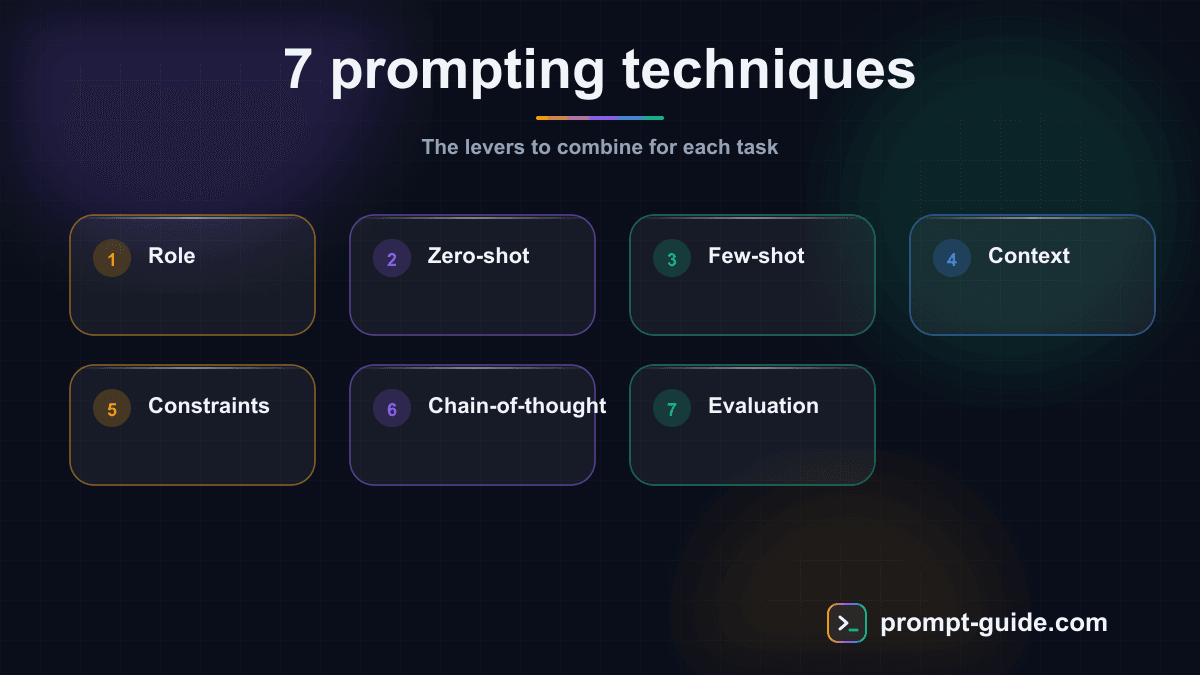
In this guide, we cover the most powerful and widely used techniques in 2025: Chain of Thought, Few-Shot Prompting, Zero-Shot CoT, Self-Consistency, Tree of Thought, Meta-Prompting, and Advanced Role Prompting. For each technique, you will find a clear explanation, concrete examples, and practical tips.
Chain of Thought (CoT): step-by-step reasoning
What is Chain of Thought?
Chain of Thought is a prompting technique that asks the model to reason step by step before giving its final answer. Introduced by Wei et al. (2022) at Google, this approach revolutionized how LLMs handle complex problems.
The principle is simple: instead of asking for the answer directly, you ask the model to break down its reasoning. This forces the model to make each logical step explicit, significantly reducing reasoning errors.
Why does CoT work?
Language models generate text token by token. Without instructions to reason, the model may "jump" directly to a conclusion, increasing the risk of errors — especially for problems requiring multiple logical steps. CoT acts as an intermediate workspace where the model can develop its reasoning before concluding.
- Measurable improvement: on math benchmarks (GSM8K), CoT improves performance by 20 to 50% depending on the model.
- Transparency: you can verify each step of the reasoning and identify where the AI goes wrong.
- Reliability: responses with CoT are generally more consistent and accurate.
How to use Chain of Thought
The simplest method is to add an explicit instruction like "Think step by step" or "Explain your reasoning before giving your answer" to your prompt.
Without CoT: "If I buy 3 items at $12.50 with a 15% discount, how much do I pay?"
With CoT: "If I buy 3 items at $12.50 with a 15% discount, how much do I pay? Think step by step and show each intermediate calculation."
Few-Shot Prompting: learning by example
What is Few-Shot Prompting?
Few-Shot Prompting involves providing a few examples (typically 2 to 5) of the task you want to accomplish before asking your question. These examples serve as a template that the AI will follow to process your request.
This technique leverages the in-context learning capability of LLMs: the model is not retrained, but uses the examples provided in the prompt to understand exactly what you expect.
How to build effective examples
The quality of your examples is critical. Follow these rules for effective Few-Shot:
Diversity
choose examples that cover different scenarios, including edge cases.
Representativeness
your examples should represent the actual task, not trivial cases.
Consistency
all examples should follow the same format and quality level.
Progression
if possible, order your examples from simplest to most complex.
Clear labeling
clearly separate input from output in each example.
Zero-Shot CoT: reasoning without examples
The Zero-Shot CoT is an elegant combination of Chain of Thought and zero-shot prompting. It simply involves adding the phrase "Let's think step by step" at the end of your prompt, without providing any reasoning examples. This simple phrase can improve reasoning performance by 10 to 40% on many tasks.
Self-Consistency: reliability through repetition
Self-Consistency involves generating multiple independent answers to the same question, then selecting the most frequent answer (majority voting). This approach exploits the fact that correct answers tend to converge, while errors are typically random.
Self-Consistency prompt: "Solve this problem using 3 different approaches. For each approach, detail your reasoning. Then compare the results and give your final answer based on the consensus."
Tree of Thought (ToT): tree-based exploration
The Tree of Thought extends Chain of Thought by allowing the model to explore multiple reasoning paths simultaneously. Instead of following a single linear thread, the model generates multiple reasoning branches, evaluates each, and pursues only the most promising ones.
ToT excels in situations where the problem has multiple possible solutions and exploration is needed before committing: creative problem-solving, strategic planning, puzzles, and complex code architecture.
Meta-Prompting: using AI to create prompts
Meta-Prompting uses AI to create, improve, or optimize prompts. It is a recursive approach: you prompt the AI to help you better prompt the AI. Applications include prompt generation, prompt improvement, template creation, and prompt debugging.
Advanced Role Prompting: beyond "You are an expert"
Advanced Role Prompting goes beyond basic role assignment by defining not just the role, but also skills, constraints, communication style, and thinking processes. A well-constructed role includes identity, competencies, style, methodology, and limitations.
Choosing the right technique
- Simple question with specific format → Few-Shot Prompting
- Reasoning problem → Chain of Thought
- Quick problem needing some reflection → Zero-Shot CoT
- Maximum reliability needed → Self-Consistency
- Complex problem with multiple approaches → Tree of Thought
- Optimizing your own prompts → Meta-Prompting
- Specific expertise required → Advanced Role Prompting
These techniques are not mutually exclusive. The best results often come from combining them strategically. Start simple and add complexity only when necessary. Master each technique individually before combining them.
Related Prompts
Design an Application Caching Strategy
Design a complete Redis caching strategy with appropriate patterns, TTL policy, invalidation, and stampede protection.
Design a Robust Microservices Architecture
A complete prompt to design a professional microservices architecture covering DDD decomposition, inter-service communication, Kubernetes deployment, and observability.
Master Advanced TypeScript Types with AI
A prompt to generate advanced TypeScript types (generics, mapped types, conditional types) with documentation and built-in type tests.
Refactor Legacy Code Step by Step
This prompt guides AI to analyze legacy code and produce a structured refactoring plan with diagnosis, prioritization, tests, and modernized code.
Source Code Security Audit
Audit your code security according to the OWASP Top 10 with vulnerability identification, exploitation PoC, and fixes.
Analyze my website's SEO performance
This Cowork prompt transforms your raw Google Search Console exports into a structured, actionable SEO audit. Claude identifies quick-wins (pages in position 5-20 to optimize), problems (cannibalization, declining pages) and generates recommendations prioritized by impact and effort. The CSV tracking table enables continuous monitoring.
Practice Exercises
Few-shot Prompting
Teach by example: guide the AI with concrete examples.
System Prompt Design
Design a complete system prompt for a professional chatbot.
Chain-of-Thought Reasoning
Force the AI to reason step by step for complex decisions.
Self-Consistency Prompting
Get reliable answers by cross-referencing multiple perspectives.
Multi-Persona Debate
Organize a debate between multiple AI personas to explore a problem.
Mega-Prompt
Create a complete mega-prompt for a specialized AI assistant.
Related guides
Continue your learning
You've finished this guide. Here's how to go further.
Practice what you learned
Interactive exercises to sharpen your prompting skills
Get new guides every week
Join our newsletter and never miss new content.