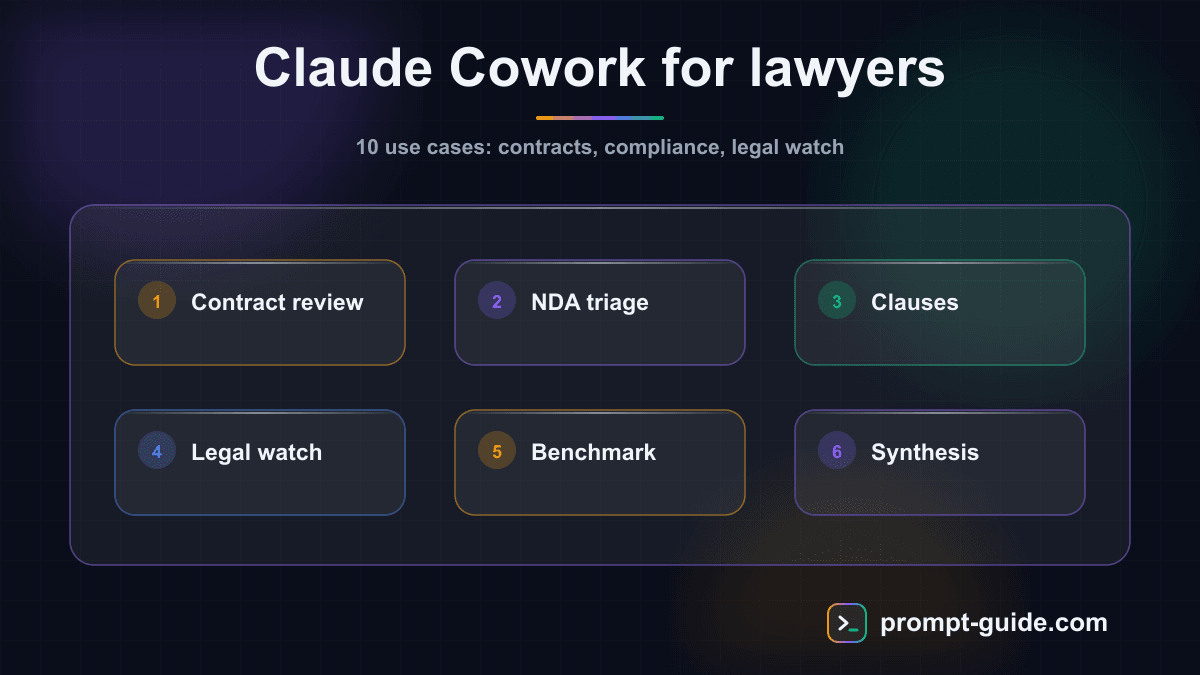
The daily legal grind under regulatory acceleration
You see it every day: the volume of texts, contracts and regulations to process keeps growing. Between new European regulations (AI Act, DORA, NIS2), evolving labor law, and tightening GDPR compliance obligations, the time spent reading, analyzing and summarizing represents an ever-increasing share of your workload.
At the same time, your clients expect faster answers, more precise analyses, and controlled fees. The equation is unsustainable without a technological lever.
Claude Cowork, the collaborative mode of Anthropic's Claude, offers exactly that lever. Unlike a generic chatbot, Cowork integrates into your work environment: it reads your documents, maintains case context over time, and produces structured analyses you can use directly. It does not replace your legal expertise. It amplifies your processing capacity.
This article presents 10 concrete use cases, tested in law firm and legal department contexts, to show you how to integrate Claude Cowork into your daily practice.
Why Claude Cowork stands out for legal work
Before diving into use cases, it is worth understanding what makes Claude Cowork particularly suited to legal work compared to other generative AI tools.
- Extended context window. Claude can process long documents -- 80-page contracts, due diligence reports, extensive case law -- without information loss. You do not need to split your documents into pieces.
- Persistent Cowork mode. Unlike a one-off conversation, Cowork maintains your case context across exchanges. You can return to a contract analyzed yesterday, add an amendment, and Claude retains the history of your instructions.
- Precision and caution. Claude is designed to flag its limitations rather than fabricate answers. In legal matters, where a false case law reference can have serious consequences, this approach is decisive.
- Confidentiality. Anthropic offers deployment options (API, Teams) where your data is not used for model training. A non-negotiable prerequisite for handling client files.
10 concrete use cases for lawyers
1. Contract review and risk clause detection
This is probably the most immediate use case. You receive a 40-page contract from the opposing party. Rather than reading it linearly for two hours, you submit it to Claude Cowork with a precise instruction:
"Analyze this software license agreement. Identify clauses that present a risk for the licensee. For each risk clause, indicate: the article number, the identified risk, the severity level (low, medium, high) and a protective rewording. Also flag missing clauses that should appear in a contract of this type."
Claude produces a structured table within minutes. You then spend your time validating and refining critical points, instead of manually hunting for each problematic clause. The time saving is in the range of 60 to 70% on the first-read phase.
2. High-volume NDA triage and analysis
Firms handling M&A transactions or fundraising rounds process dozens of NDAs per week. Most are similar, but each contains subtleties: confidentiality scope, duration, exceptions, applicable jurisdiction.
With Claude Cowork, you can create a triage workflow. Submit each NDA with the following instruction:
"Compare this NDA against our standard template [previously provided to Claude]. List the deviations in three categories: acceptable as-is, to be negotiated, and unacceptable. For unacceptable deviations, propose a replacement clause aligned with our standard position."
This process transforms a 30-minute task per NDA into a 5-minute review. On a deal with 15 NDAs, you recover half a day.
3. Specific clause analysis and benchmarking
Beyond global review, Claude Cowork excels at fine-grained analysis of particular clauses. Negotiating a liability limitation clause? Ask Claude:
"Analyze this liability limitation clause in the context of a B2B SaaS contract. Evaluate its validity under applicable law and recent case law on limitation clauses. Compare it to market standards for a SaaS contract of this size (ARR above 500K). Propose three levels of rewording: maximum position, balanced position, fallback position."
You get a structured opinion that directly feeds your negotiation strategy.
4. Targeted regulatory watch
The law evolves constantly. The European AI Act, NIS2 directive transposition, labor law changes related to remote work -- staying current requires constant investment.
Claude Cowork lets you structure an efficient watch. Each week, provide it with published texts (Official Journal, EUR-Lex) and ask:
"Among the texts published this week, identify those that impact [your client's sector or practice area]. For each relevant text, produce a briefing: full reference, effective date, 5-line summary, concrete impact for our clients, required actions and deadlines."
You get a weekly actionable summary that you can forward to clients as a legal newsletter -- a high-value service that builds loyalty.
5. GDPR compliance: audits and documentation
GDPR compliance remains a major topic for firms advising companies on their compliance journey. Claude Cowork can significantly accelerate several aspects of the work.
Pre-compliance audit. Provide Claude with your client's data processing descriptions and request a point-by-point assessment: legal basis, proportionality, retention period, transfers outside the EU, security measures. Claude produces a structured report that you then refine.
Documentation drafting. Records of processing activities, processor clauses (Article 28 GDPR), Data Protection Impact Assessments (DPIA) -- these documents follow standardized structures that Claude handles well. Provide the factual context and it produces a first draft compliant with regulatory guidelines.
Data subject rights responses. A client receives an access right or erasure request? Claude can prepare the draft response while respecting the timelines and formats required by GDPR (Articles 12 to 23).
6. Client briefing and case summary preparation
Before each client meeting, you need to summarize the state of a case: exchange history, filed documents, pending issues, recommended strategy. This compilation work is time-consuming.
With Claude Cowork, you can structure this preparation:
"Based on the following documents [case files], prepare a briefing note for tomorrow's client meeting. Structure: (1) fact summary and timeline, (2) procedural status, (3) strengths and weaknesses analysis, (4) strategic options with advantages and risks of each, (5) reasoned recommendation, (6) questions to ask the client."
Claude produces a working document that you adjust in 15 minutes, instead of writing it from scratch in an hour.
7. Legal research and case law analysis
Legal research is at the heart of a lawyer's work, but it is time-intensive. Claude Cowork does not replace legal databases (Westlaw, LexisNexis, Practical Law), but it excels at analysis and synthesis once you have gathered your sources.
Provide it with a series of decisions and ask:
"Analyze these 8 decisions rendered between 2023 and 2026 on the question of [topic]. Identify the case law trend, the criteria retained by the court, the points of divergence between decisions, and synthesize the current judicial position. Conclude with a recommendation for our case [case context]."
This type of cross-analysis, which would take a full day of manual reading, is produced in minutes. Your role is to validate the reasoning and integrate the nuances that only your practitioner expertise can identify.
8. Litigation file synthesis (Case Summarization)
In complex litigation, the volume of documents can become considerable: opposing submissions, disclosed documents, court orders, correspondence. Claude Cowork can process everything and produce a case map.
"Here is the complete set of documents for this [commercial litigation] case. Produce: (1) an exhaustive fact timeline with document references, (2) a summary of each party's claims, (3) an analysis of the legal arguments raised, (4) a table of key documents with their estimated evidentiary weight, (5) weak points in our position and the most dangerous opposing arguments."
This map becomes your litigation management tool. It evolves throughout the case: with each new document or submission, Claude updates the analysis within the global context.
9. Memorandum and legal opinion drafting
The legal opinion is a high-value deliverable. Claude Cowork can accelerate its production without sacrificing quality.
The process is iterative. You start by providing the factual context and legal question. Claude produces a structured first draft (fact summary, applicable legal framework, analysis, conclusion). You annotate, correct, request deeper analysis on certain points. Claude integrates your feedback and produces a revised version.
This back-and-forth, which works naturally in Cowork mode, allows you to produce a quality memorandum in two to three hours instead of a full day. The intellectual value remains yours: you direct the analysis, validate the legal reasoning, and take responsibility for the conclusion.
10. Training and junior associate development
An often overlooked use case: Claude Cowork as a training tool for junior associates. Rather than assigning them legal research without structure, you can configure Claude to support their learning process.
"You are a senior lawyer supervising a second-year associate. The associate will submit their analysis of [legal topic]. Your role: identify reasoning errors, flag missing sources, ask Socratic questions to push them toward deeper analysis, and evaluate the quality of their legal writing. Do not give the answer directly -- guide them."
This "tutor" mode allows your associates to progress faster while freeing up partner supervision time.
Integration methodology: where to start
Adopting Claude Cowork in a firm does not happen overnight. Here is a progressive approach that has proven effective.
Phase 1: Individual experimentation (weeks 1-2). One or two lawyers test Claude Cowork on low-stakes tasks: case law synthesis, first-pass contract review, internal note preparation. The goal is to measure actual time savings and identify limitations for your types of cases.
Phase 2: Standardization (weeks 3-6). You create standardized prompts for the firm's recurring tasks: contract review template, GDPR audit grid, briefing note format. These templates become shared tools within the team. See our Claude Cowork learning guide for mastering the configuration fundamentals.
Phase 3: Workflow integration (weeks 7-12). Claude Cowork integrates into your existing processes: every new contract goes through automated first analysis, regulatory watch is systematized, pre-meeting briefing notes are generated automatically. AI becomes a reflex, not an additional effort.
Ethical precautions and best practices
Using AI in legal practice raises legitimate ethical questions. Here are the principles to respect without exception.
- Professional privilege. Verify your AI provider's data processing terms. Prefer offerings with contractual commitments not to use data for training (Claude API, Claude Teams). Never submit client data on a free version without confidentiality guarantees.
- Professional liability. AI produces a work support, not a final deliverable. Every document generated by Claude must be reviewed, validated and assumed by the lawyer who signs it. Your professional liability remains full.
- Transparency. The question of disclosing AI usage to your clients is increasingly relevant. Adopt a clear position consistent with your bar association's recommendations.
- Systematic verification. Every legal reference produced by Claude (statutes, case law, dates) must be verified against official sources. AI models can generate fictitious references -- in legal matters, this is unacceptable.
- Complementarity, not substitution. Claude Cowork excels at processing, analysis and synthesis tasks. Strategic legal reasoning, advocacy, client relationships and personalized advice remain irreplaceable human competencies.
What this concretely changes
Firms and legal departments that have integrated Claude Cowork into their practice report measurable gains:
- Contract review: 60 to 70% reduction in first-read time.
- Regulatory watch: from 4 hours per week down to 45 minutes of supervision.
- Case preparation: briefing notes produced in 20 minutes instead of 90.
- GDPR compliance: pre-audits completed in half a day instead of two days.
- Legal research: case law syntheses produced in 15 minutes instead of 3 hours.
These gains do not translate into headcount reduction. They translate into increased capacity to handle more cases, deepen analyses, and devote more time to client relationships and strategic advice -- the activities where a lawyer's added value is highest.
Conclusion
Claude Cowork is not a tech gadget for firms seeking modernity. It is a productivity tool that addresses a real constraint: doing more and better within the same number of hours in the day.
The 10 use cases presented in this article cover the essentials of daily legal work: contracts, compliance, regulatory watch, litigation, research, training. Each can be implemented today, without heavy infrastructure or special technical skills.
The question is no longer whether AI has a place in legal practice. It is already there. The real question is whether you will integrate it in a structured and ethical manner, or leave that advantage to your peers.
To deepen your mastery of Claude Cowork and discover other professional applications, see our complete Claude Cowork guide.

Prompt Guide
Founder of Prompt Guide and CEO of Webpulser. Digital and AI entrepreneur since 2006, he shares his field-tested prompt engineering techniques.
Practice what you learned
Interactive exercises to sharpen your prompting skills
Master Claude Cowork in 5 days
Get one email per day for 5 days with practical exercises, ready-to-use prompts and pro tips.
- 1Day 1: Setup and global instructions
- 2Day 2: Skills - customize your assistant
- 3Day 3: Scheduled tasks and automations
- 4Day 4: Plugins, connectors and Computer Use
- 5Day 5: Advanced workflows and business use cases
Claude Code AI Workspace Kit
A kit to structure your context and workspace with Claude Code.
- A workspace for Claude Code
- Ready-to-use context files
- A framework to organise your work
Related Prompts
Developer Resume Prompt
Write a developer resume from your stack, your projects and the target job posting.
Preparing for a developer technical interview: prompt
A prompt to prepare for a developer technical interview: questions on your stack, live coding, architecture, and trick questions.
Tricky Interview Questions: A Prompt to Prepare Your Answers
Anticipate tricky job interview questions, including the ones aimed at your weakness.
Preparing for a Sales Interview: Prompt
Prepare for a sales interview with likely questions, a personal pitch, and a graded sales simulation.