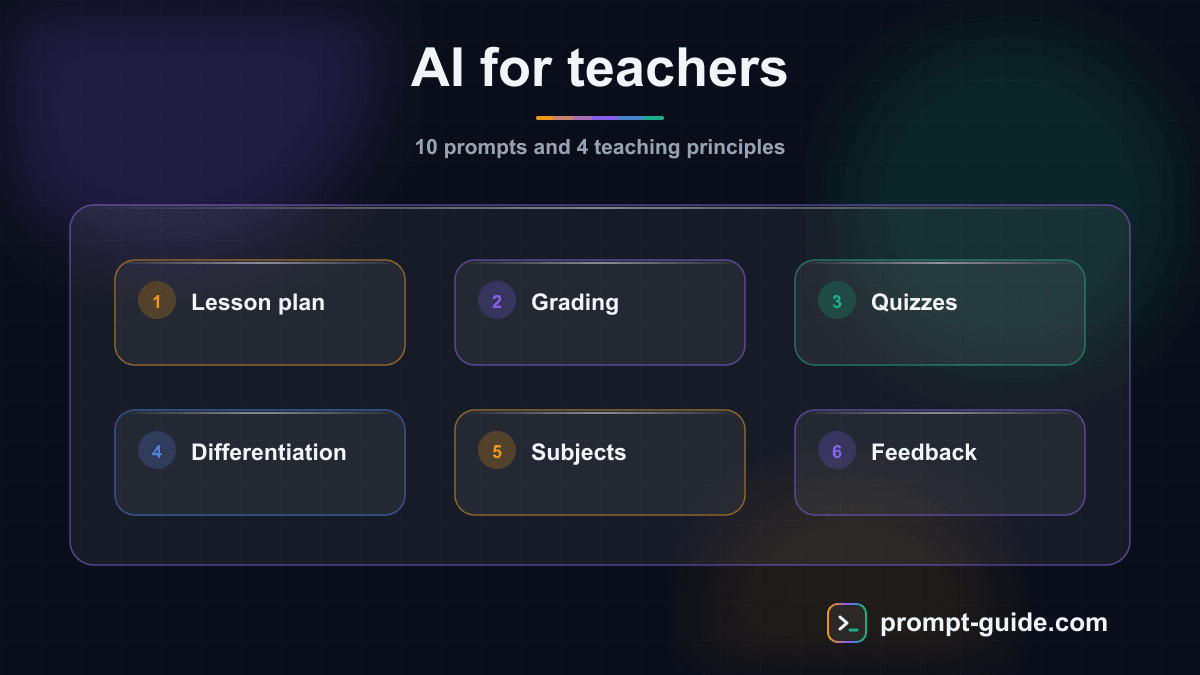
Why AI has become teachers' #1 ally
In 2026, artificial intelligence is no longer a technological curiosity in education — it's an everyday tool. According to recent studies, over 65% of teachers regularly use an AI assistant to prepare lessons, grade papers, or create personalized exercises. And it's not a fad: it's a concrete response to very real problems.
Overcrowded classrooms, mixed ability levels, growing administrative burden, pressure on results... You know the drill. AI doesn't replace teachers — it gives them back time and energy for what truly matters: the educational relationship with students.
But here's the problem: most teachers who try AI get mediocre results. Not because the tool is bad, but because they don't know how to frame their requests. A well-crafted teacher prompt makes all the difference between a generic, unusable response and professional-quality educational content.
In this guide, you'll discover exactly how to formulate your prompts for every teaching situation — with concrete examples you can copy-paste and adapt immediately. If you want to go even further, our prompt builder lets you create custom instructions in just a few clicks.
Educational prompt fundamentals
What separates a good prompt from a bad one
The golden rule: the more context you provide, the better the result.
A bad prompt: "Create a lesson on the French Revolution." Too vague. The AI doesn't know for what grade level, what duration, what angle, or what learning objectives.
A good educational prompt systematically includes:
- The role: You are an experienced [subject] teacher at the [level].
- The context: class of 30 students, mixed ability levels, [curriculum] program.
- The learning objective: targeted skills, what the student should be able to do by the end.
- The expected format: detailed plan, exercises with answer key, 10-question quiz...
- The constraints: duration, adapted vocabulary, source inclusion, etc.
4 principles of effective teacher prompts
1. Always specify the grade level. A math exercise for a 6th grader is nothing like one for a 12th grader.
2. Give examples of what you expect. If you want a certain grading style, show a sample comment. The AI will match your standard.
3. Ask for iterations. Never settle for the first result. Ask the AI to simplify, deepen, add variants.
4. Integrate Bloom's Taxonomy. Frame your learning objectives using Bloom's action verbs (identify, analyze, evaluate, create...). The AI understands this framework perfectly.
10 concrete prompts for every teaching situation
1. Create a structured lesson plan
2. Grade papers with constructive feedback
3. Generate quizzes and assessments
4. Create differentiated exercises
5. Subject-specific exercises
Mathematics
Foreign Languages
6-7. Essay methodology and science investigations
Additional prompts cover essay writing methodology kits (analysis, brainstorming, outlines, argument banks) and science investigation sessions with hypothesis formation, experimental protocols, and structured conclusions.
Advanced use cases
Exam preparation
Ask the AI to analyze the last 5 years of exam papers to identify recurring themes and question types. You get a data-driven revision strategy, not one based on intuition.
Personalized AI tutoring
Configure the AI to ask Socratic questions rather than giving answers directly: "When the student asks a question, never give the answer directly. Ask an intermediate question that guides them toward the solution."
Professional development training
The same principles apply to adult education. Adjust by replacing pedagogy with andragogy, exercises with case studies, and tests with professional simulations.
Mistakes to avoid
- Never use AI content without reviewing it. AI can produce factual errors, especially in history and science.
- Don't overload the prompt. A prompt asking 15 different things produces superficial results. Three focused prompts beat one mega-prompt.
- Don't forget curriculum alignment. Always mention the official standards so generated content is actually usable.
- Don't neglect ethics. Inform your students when you use AI to create materials. Transparency builds trust.
FAQ — Teachers' most common questions about AI
Will AI replace teachers?
No. AI excels at repetitive, time-consuming tasks. But it can't motivate a struggling student, manage group dynamics, or adapt in real-time to an unexpected reaction. The heart of the profession — human connection, empathy, professional judgment — remains irreplaceable.
How do I ensure AI-generated content is reliable?
Apply the 3V rule: Verify, Validate, Vary. Verify facts and formulas. Validate pedagogical coherence. Vary your sources — don't rely solely on AI.
My students use ChatGPT to cheat. What should I do?
Rather than banning it (a losing battle), integrate AI into your teaching. Teach students to use it critically. Adapt assessments: favor oral presentations, in-class work, original document analysis, and productions requiring personal reflection.
Take action today
You now have a complete arsenal of prompts to transform your teaching practice:
- Step 1: Choose ONE prompt that addresses your most immediate need.
- Step 2: Adapt it to your subject, level, and context.
- Step 3: Test it, evaluate the result, and adjust.
- Step 4: Explore our prompt library for hundreds more templates.
Every minute AI saves you on administrative tasks is a minute you can reinvest in what makes this profession beautiful: guiding your students toward success.
Ready to go further? Use our prompt builder to create perfectly calibrated instructions for your subject and level — no technical skills required.

L'Art du Prompting
Founder of Prompt Guide and CEO of Webpulser. Digital and AI entrepreneur since 2006, he shares his field-tested prompt engineering techniques.
Practice what you learned
Interactive exercises to sharpen your prompting skills
Stay Updated
Get our best articles and techniques every week.
Related Prompts
Transform long content into catchy social media posts
Transform your articles and long-form content into short, engaging social media publications.
Create Catchy Social Media Headlines
Generates punchy, optimized headlines for your social media posts, adapted to your audience and platform.
Summarize long articles or documents into clear summaries
Condense articles, reports, and lengthy documents into structured and directly usable summaries.
Write Professional Blog Posts and White Papers
Create engaging blog posts and professional white papers that strengthen your industry expertise.