The average legal professional spends 30 to 40% of their time on repetitive tasks: reviewing clauses, checking compliance, summarizing case law. What if you could reclaim some of those hours every week?
ChatGPT won't replace your lawyer. Let's be clear about that. But used with the right prompts, it becomes a formidable legal assistant — capable of producing a first draft contract in 2 minutes, scanning a document for risks, or summarizing 50 pages of case law into one actionable paragraph.
The problem? Most people type "draft me a contract" and get a generic result riddled with approximations. Output quality depends entirely on prompt quality. And in law, approximations can be very costly.
In this article, you'll discover how to structure your prompts to get reliable, actionable legal results. With concrete examples, ready to copy-paste, adapted for practical use.
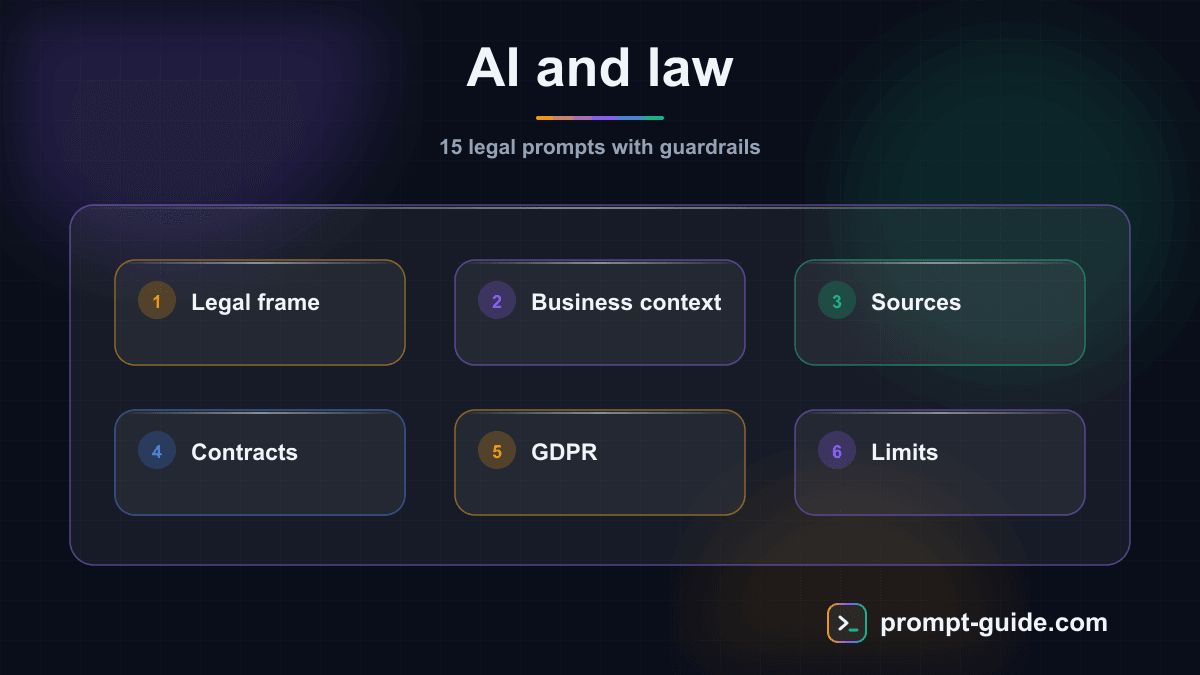
Why AI is a game changer for legal professionals
The legal sector is undergoing a quiet revolution. Legaltech companies are multiplying, law firms are integrating AI into their workflows, and even small businesses are starting to use ChatGPT for their daily legal needs.
Three factors explain this acceleration:
- The volume of regulation is exploding. Between GDPR, industry-specific regulations, evolving employment law, and new digital acts, staying current has become a full-time job. AI lets you process this volume without burning out.
- Legal costs remain high. A lawyer consultation starts at $300-500 per hour. For a startup or freelancer, using AI to prepare the groundwork before consulting a professional saves both time and money.
- Model quality has crossed a threshold. GPT-4 and its successors understand legal nuances — provided you give them the right context.
The golden rules of legal prompting
Before diving into examples, you need to understand what separates a prompt that produces legal fluff from one that generates an actionable document.
Rule #1: Always specify the legal framework
ChatGPT was trained on law from around the world. If you don't specify your jurisdiction, you might end up with clauses from a completely different legal system — and that won't hold up in your local court.
Always mention: the country or state, the area of law (employment, commercial, consumer protection, etc.), and where relevant, the specific statutes or regulations that apply.
Rule #2: Provide the business context
"Draft a contract" isn't enough. The AI needs to know: who are the parties? What's the subject matter? What's the duration? Are there industry-specific considerations? The more context you provide, the more precise and usable the result.
Rule #3: Ask for sources and limitations
A good legal prompt always asks the AI to cite relevant statutes and flag areas of uncertainty. This is your safety net: you know exactly where to verify and where to have a professional review.
Rule #4: Never use as-is
AI produces a first draft. Not a final document. Every output must be reviewed, adapted to your specific case, and — for important documents — validated by a legal professional. This is non-negotiable.
If you're new to prompt engineering, the prompt builder can help you structure your requests with the right methodology.
15 concrete legal prompts, ready to use
Let's get practical. Here are tested, optimized prompts for the most common legal use cases. Each prompt is designed to produce a structured, actionable result.
1. Draft a service agreement
The service agreement is probably the most requested document by freelancers and small businesses. This prompt produces a solid foundation:
This prompt works because it provides the full context: parties, subject, amount, and the specific clauses expected. The AI doesn't have to guess — it executes.
2. Analyze GDPR / data privacy compliance
Data privacy remains a major concern for businesses. This prompt turns ChatGPT into a first-level privacy auditor:
This type of automated audit doesn't replace a real DPO, but it lets you identify obvious gaps before paying for a consultation. You'll find more prompts like this in our prompt library.
3. Generate compliant Terms and Conditions
Terms and Conditions are mandatory for any e-commerce business. Poorly drafted, they expose you to legal liability. This prompt produces structured T&Cs:
4. Draft a formal demand letter
A formal demand letter is often the first step before legal action. It must be firm, precise, and legally grounded:
The demand letter is a document where the precision of facts and legal references makes all the difference. Note how the prompt specifies tone and format — two elements AI handles very well when made explicit.
5. Summarize and analyze a court decision
Legal research is time-consuming. This prompt saves you hours on case law analysis:
6. Audit contract clauses
Received a contract to sign and want to spot the traps before committing? This prompt is made for that:
7. Draft compliant legal notices for a website
8. Analyze an employment law issue
Advanced use cases: going further with legal AI
The prompts above cover common needs. But legal AI goes much further when you know how to push the boundaries.
Automated legal monitoring
Instead of scanning legal publications every morning, you can ask AI to synthesize the developments that matter to you. Combine ChatGPT with an RSS feed of legislative publications, and use a prompt like:
"Analyze the following texts published this week. Identify those that impact [your industry]. For each relevant text: 3-line summary, concrete impact, actions to take, deadline if any."
Our ready-to-use AI agents can fully automate this type of workflow — an agent monitors, summarizes, and alerts you only when it's relevant.
Comprehensive compliance audit
You can build a chained prompt that sequentially audits: data privacy, legal notices, terms and conditions, cookie policy, and subprocessor agreements. Each step feeds into the next. This is the principle of "prompt chaining" — a technique you can master with our practical exercises.
Intellectual property and AI
A hot topic: who owns the rights to AI-generated text? In most jurisdictions, copyright protects "works of authorship" involving original human creative contribution. A purely AI-generated text, without creative human intervention, is likely not protectable.
Practically speaking, if you use ChatGPT to draft a contract or terms and conditions, you should rework the text enough to add your own personal touch. Paradoxically, AI forces you to be more creative, not less.
Compliance and commercial law
For businesses subject to compliance obligations (anti-corruption laws, duty of care, international sanctions), AI excels at screening. Give it your risk mapping and ask it to identify gaps. It's not a substitute for a structured compliance program, but it's a powerful accelerator for first-level analysis.
Building custom legal prompts
Every legal situation is unique. Rather than searching for the perfect prompt each time, learn to build your own. The prompt builder guides you step by step: you select the legal area, document type, and desired level of detail, and you get a structured prompt tailored to your exact need.
Limitations to know (and respect)
Enthusiasm shouldn't overshadow the risks. Here's what AI cannot do in legal matters:
- Provide personalized legal advice. AI provides general information. Only a licensed attorney can give you legal advice that carries professional liability.
- Guarantee 100% accuracy. Models can "hallucinate" — inventing statutes that don't exist or citing fictional case law. Always verify against official sources.
- Replace recent case law. Models have a knowledge cutoff date. A ruling from last week won't be in the knowledge base.
- Handle confidentiality. Never paste personal data or confidential documents into ChatGPT without checking the service's privacy policy and, ideally, using the API or Enterprise version with training opt-out.
FAQ: AI and law in practice
Can ChatGPT replace a lawyer?
No. ChatGPT is a drafting and analysis tool, not a legal professional. Unauthorized practice of law is a serious offense in most jurisdictions. AI can prepare a first draft, identify risks, and summarize case law — but final legal advice and court representation remain the domain of licensed attorneys. Use AI to arrive better prepared at your lawyer's office, not to avoid going there.
Do AI-generated documents have legal validity?
A contract or legal document is legally valid as long as it meets the standard conditions of validity (mutual consent, capacity, lawful purpose). It doesn't matter whether it was drafted by a human, an AI, or a medieval scribe. What counts is the content and the parties' signatures. However, a poorly drafted AI document could contain void or unenforceable clauses — which is why human review is essential.
How do I avoid legal hallucinations from ChatGPT?
Three techniques that work: (1) always ask the AI to cite exact statutes and verify them against official legal databases; (2) use the prompt "If you're uncertain about a legal point, explicitly state so rather than making something up"; (3) cross-reference results with a second source (legal databases or a second AI model). Hallucinations are more common with case citations (fabricated cases) than with statutes — be especially vigilant about case references.
Can I use ChatGPT for my company's GDPR compliance?
Yes, but as a pre-audit tool, not a complete solution. ChatGPT can help you map your data processing activities, identify appropriate legal bases, draft privacy clauses, and prepare your processing records. But GDPR compliance is an ongoing process requiring intimate knowledge of your business. For high-risk processing (sensitive data, profiling, transfers outside the EU), have it validated by a qualified DPO.
Am I taking a risk by using AI to draft my contracts?
The risk isn't in using AI, but in using it without verification. If you sign a contract containing an unconscionable clause generated by ChatGPT, you bear the consequences — not OpenAI. The real danger is false confidence: believing that because the text "looks legal," it's legally sound. Treat every AI output as a first draft, not a final document. And for high-stakes matters (fundraising, employment contracts, litigation), invest in a lawyer.
Which version of ChatGPT should I use for legal work?
GPT-4 and newer models are significantly better than GPT-3.5 for legal tasks. They understand nuances better, structure documents more effectively, and hallucinate less. If you work regularly on legal documents, a ChatGPT Plus subscription or API access is worth the investment. Anthropic's Claude models are also strong for legal analysis, with a larger context window — useful for analyzing long contracts.
Take action
You now have a complete toolkit for using AI in your daily legal work. The prompts in this article cover 80% of common needs: contracts, data privacy compliance, terms and conditions, demand letters, legal monitoring, and case law analysis.
But the real power is knowing how to build your own prompts tailored to your situation. Every case is different, every clause has its subtleties.
To go further:
- Explore the prompt library for more ready-to-use legal templates
- Use the prompt builder to create custom prompts for your specific cases
- Try our specialized AI agents to automate your monitoring and compliance audits
- Practice with our practical exercises to master legal prompt engineering
AI doesn't replace the law. It makes the law more accessible. And those who master this tool today will have a considerable competitive advantage tomorrow — whether you're a lawyer, entrepreneur, or simply someone who wants to understand their rights.

L'Art du Prompting
Founder of Prompt Guide and CEO of Webpulser. Digital and AI entrepreneur since 2006, he shares his field-tested prompt engineering techniques.
Practice what you learned
Interactive exercises to sharpen your prompting skills
Stay Updated
Get our best articles and techniques every week.
Related Prompts
Transform long content into catchy social media posts
Transform your articles and long-form content into short, engaging social media publications.
Create Catchy Social Media Headlines
Generates punchy, optimized headlines for your social media posts, adapted to your audience and platform.
Summarize long articles or documents into clear summaries
Condense articles, reports, and lengthy documents into structured and directly usable summaries.
Write Professional Blog Posts and White Papers
Create engaging blog posts and professional white papers that strengthen your industry expertise.