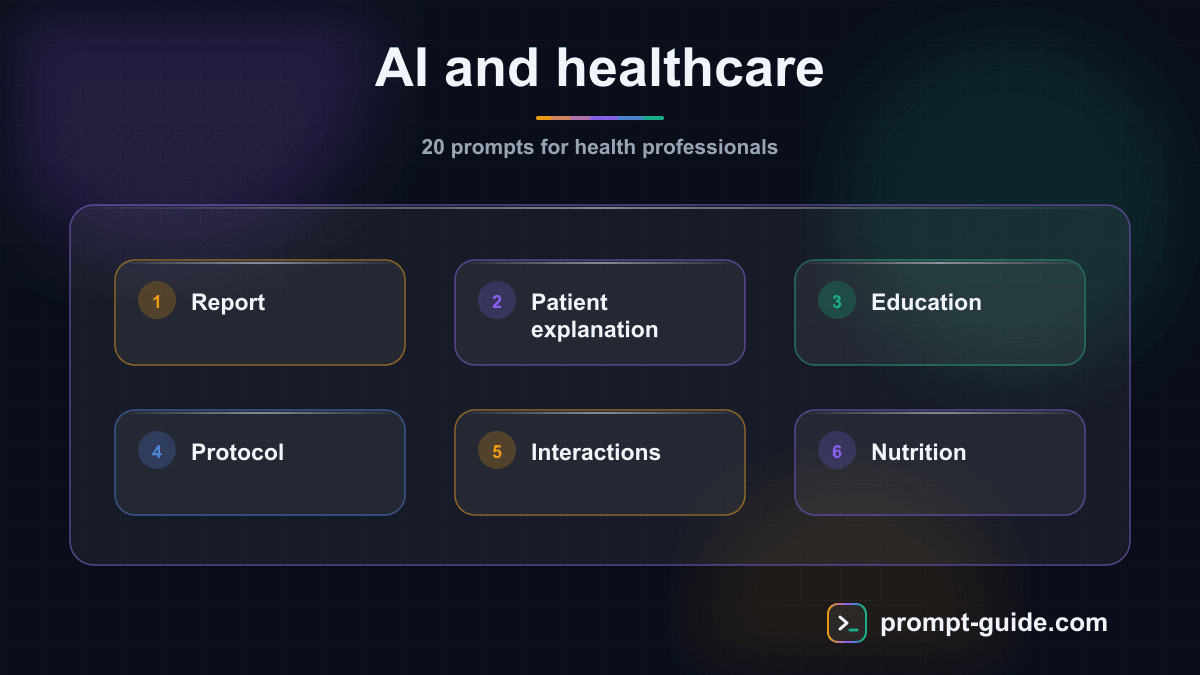
Why AI has become essential in healthcare
If you work in healthcare, you know better than anyone: time is your most precious resource. Between consultations, writing reports, updating patient records, continuing education, and communicating with teams, the days are never long enough. This is exactly where artificial intelligence comes in — not to replace your clinical expertise, but to amplify your productivity on all the tasks that surround the medical act itself.
According to a study published in The Lancet Digital Health, healthcare professionals who use AI tools for writing and analysis save an average of 45 minutes per day. But you still need to know how to formulate the right requests. A well-crafted healthcare AI prompt makes all the difference between a generic, unusable response and a result you can use directly in your practice.
In this article, you'll discover 20 concrete prompts, organized by area of application, that you can copy-paste and adapt immediately to your professional context. Whether you're a general practitioner, nurse, pharmacist, psychologist, nutritionist, or researcher, there are prompts for you.
Healthcare prompt engineering fundamentals
Why context is king in medical settings
In healthcare more than any other field, the quality of your request determines the quality of the response. A vague prompt like "tell me about diabetes" will never give you a usable result in a clinical setting. However, a prompt that specifies the patient profile, the clinical context, the expected output format, and the desired language level will produce content you can use directly.
If you're new to prompt engineering, our prompt builder lets you structure your requests step by step, without needing to master all the advanced techniques.
The 5 golden rules of medical prompting
- Always specify the role: ask the AI to act as a specialist in the relevant field.
- Provide the clinical context: patient age, medical history, reason for visit.
- Specify the format: structured report, bullet points, patient-friendly language.
- State the constraints: clinical guidelines, evidence level, references required.
- Always verify: AI is an assistant, never a decision-maker. Every output must be validated by your clinical expertise.
Important: never enter real patient personal data into a public AI tool. Always use anonymized or fictional data in your prompts. HIPAA compliance, GDPR, and patient confidentiality remain your responsibility.
20 AI prompts for healthcare professionals
1. Write a consultation report
The consultation report prompt is probably the one that will save you the most time on a daily basis. Instead of writing each report from scratch, give the AI the key elements and let it structure the document.
2. Simplify an explanation for a patient
Patient communication is an art. This prompt helps you transform complex medical jargon into a clear, reassuring explanation — perfect for patient education.
3. Create a patient education program
Patient education is essential for chronic conditions. This prompt lets you structure a complete program in minutes.
4. Develop a nursing care protocol
This nursing protocol prompt is particularly useful for nurses who need to formalize standardized procedures in their unit.
5. Analyze drug interactions
An essential pharmacy prompt for community and hospital pharmacists who want a quick, structured analysis.
6. Create a personalized nutrition plan
This nutrition AI prompt is ideal for dietitians and nutritionists who want to generate a meal plan foundation to then customize.
7. Write a patient chart note
Managing patient records is time-consuming. This prompt helps you structure clear, complete notes to ensure care traceability.
8. Prepare a healthcare training session
Whether you're an instructor in a nursing program or responsible for continuing education at your facility, this healthcare training prompt saves you hours of preparation.
9. Structure a telemedicine consultation
Telemedicine has become part of everyday practice. This telemedicine prompt helps you structure your virtual visits optimally.
10. Design a preventive health program
This preventive health prompt is perfect for public health physicians, occupational health doctors, and prevention program coordinators.
11. Support a mental health patient
This mental health and psychology prompt helps psychologists and psychiatrists structure their therapeutic approaches.
12. Summarize medical research
For professionals involved in medical research, this prompt saves considerable time on literature reviews.
13. Manage a pharmacy emergency situation
A practice-oriented pharmacy prompt for managing sensitive situations at the counter.
14. Create a workplace wellness resource
Healthcare worker wellbeing matters too. This wellness prompt helps you design resources for yourself and your colleagues.
15. Write a referral letter between clinicians
Interprofessional communication is crucial. This prompt helps you write clear, complete referral letters.
16. Design a pre-visit questionnaire
Optimize your consultation time by preparing smart questionnaires that patients complete beforehand.
17. Adapt a protocol for pediatrics
Pediatric specificities require careful adaptations. This prompt helps you formalize them.
18. Interpret lab results
This prompt helps you interpret and contextualize lab results for informed clinical decision-making.
19. Prepare a motivational interview
Motivational interviewing is a powerful tool for supporting behavior change in patients.
20. Create a quality dashboard for a department
For nurse managers and quality officers, this prompt helps structure indicator tracking.
Advanced use cases: going further with AI in healthcare
Chaining prompts for a complete workflow
The real power of AI emerges when you chain multiple prompts into a coherent workflow. For example, for a complex consultation:
Prompt 1
analyze the chief complaint and propose differential diagnoses.
Prompt 2
generate the workup to order based on the retained hypotheses.
Prompt 3
write the consultation report and referral letter if needed.
Prompt 4
create the patient information sheet.
This sequential approach lets you build a complete file in minutes. You can discover more examples of this type of chaining in our prompt library, where hundreds of templates are organized by field.
Using AI agents to automate repetitive tasks
Beyond individual prompts, our ready-to-use AI agents let you automate entire workflows. Imagine an agent that, every week, compiles your department's quality indicators, identifies anomalies, and generates a summary report. Or an agent that automatically prepares a chart summary before each scheduled appointment.
Agents are particularly relevant for:
- Automated literature monitoring on your research topics
- Protocol compliance tracking and deviation detection
- Generating standardized periodic reports
- Preparing for multidisciplinary team meetings
Customizing your prompts with the builder
Every healthcare professional has specific needs. A psychiatrist doesn't use AI the same way as a physical therapist. That's why it's essential to customize your prompts based on your specialty, practice setting, and patients. The prompt builder guides you step by step to create tailored templates you can reuse daily.
Ethics and regulatory considerations
Using AI in healthcare raises important ethical questions that must never be overlooked:
- Confidentiality: never enter identifiable data into an AI tool that isn't certified for health data hosting (HIPAA-compliant, HDS-certified, etc.).
- Responsibility: AI doesn't make diagnoses. You do. Every suggestion must be validated by your clinical judgment.
- Bias: AI models can reproduce biases present in their training data. Stay critical.
- Transparency: inform your patients if you use AI tools in your practice, in line with data protection transparency principles.
FAQ: AI for healthcare professionals
Can AI replace a medical diagnosis?
No, absolutely not. AI is a clinical decision support tool, not a decision-maker. It can help you structure your diagnostic thinking, suggest differential diagnoses you might not have considered, or synthesize complex data. But diagnosis remains a medical act that falls under your professional responsibility and clinical expertise. No current AI model can integrate the full range of non-verbal signals, clinical intuition, and human context that only you perceive in a consultation.
How do I ensure patient data confidentiality with AI?
This is the most important question. Here are the rules to follow strictly: never enter personally identifiable patient data (name, date of birth, social security number) into a public AI tool. Always use fictional or anonymized cases. If your institution has an AI tool hosted in a HIPAA-compliant or certified health data environment, use that instead. For now, think of AI as a drafting assistant, not a health data processing tool. HIPAA, GDPR, and medical confidentiality apply — especially — in the AI era.
What are the best AI models for healthcare?
General-purpose models like Claude (Anthropic) and GPT-4 (OpenAI) are the most versatile for the use cases described in this article. They excel at writing, summarizing, and structuring medical information. For more specialized uses, there are models trained specifically on medical data (Med-PaLM, BioGPT), but they're less accessible. What matters most isn't the model — it's the quality of your prompt. A good prompt on a general model will always produce better results than a bad prompt on a specialized model. That's why we recommend practicing with our practical exercises in prompt engineering.
How long does it take to master medical prompt engineering?
You can get useful results from your very first use by applying the 5 golden rules we detailed above. Finer mastery — knowing how to refine a prompt that isn't delivering, chaining requests, creating reusable templates — develops over a few weeks of regular practice. The most important thing is to start. Every interaction with AI teaches you something. In 2-3 weeks of daily use, you'll have developed reflexes that save you considerable time.
Can AI help me with medical research and literature reviews?
Yes, it's actually one of its strongest areas. AI can help you formulate PICO search strategies, identify relevant MeSH keywords, summarize articles, compare study methodologies, and identify gaps in the literature. However, it can't directly query databases like PubMed in real time (unless it has web access). Use it as a methodological assistant to structure your research, then always verify the references it provides.
Conclusion: take action today
AI isn't going to transform healthcare tomorrow — it's transforming it today. The 20 prompts you've just discovered are only a starting point. Each one can be adapted, refined, and combined to meet your specific daily needs.
The most important thing is to start now. Pick a single prompt from this list — the one that addresses your biggest daily frustration — and test it during your next workday. You'll be surprised by the time saved and the quality of the results.
To go further, explore our prompt library with hundreds of templates organized by field, try the prompt builder to create your own personalized templates, and sharpen your skills with our practical exercises in prompt engineering.
Medicine has always known how to integrate technological innovations in service of the patient. AI is the next one — and you've already taken the first step by reading this article.

L'Art du Prompting
Founder of Prompt Guide and CEO of Webpulser. Digital and AI entrepreneur since 2006, he shares his field-tested prompt engineering techniques.
Practice what you learned
Interactive exercises to sharpen your prompting skills
Stay Updated
Get our best articles and techniques every week.
Related Prompts
Write a SKILL.md for Hermes Agent: turn a repetitive task into a skill
Converts a freely described manual task into a structured SKILL.md for Hermes Agent: triggers, preconditions, procedure, checks, failure cases, report.
Create Math Exercises Adapted to Your Students Level
A comprehensive prompt to generate progressive math exercises with detailed answer keys, adapted to the grade level and chosen topic.
Résumer un cours pour réviser efficacement avec l'IA
Un prompt qui transforme n'importe quel cours ou ensemble de notes en fiche de révision structurée, claire et facile à mémoriser, adaptée à votre niveau et à votre échéance.
Create an Immersive Educational Role-Playing Game for Students
This prompt generates a turnkey educational role-playing game with scenario, character sheets, rules, resources and teacher guide adapted to your subject and level.