ChatGPT vs Claude: Prompting Comparison and Use Cases
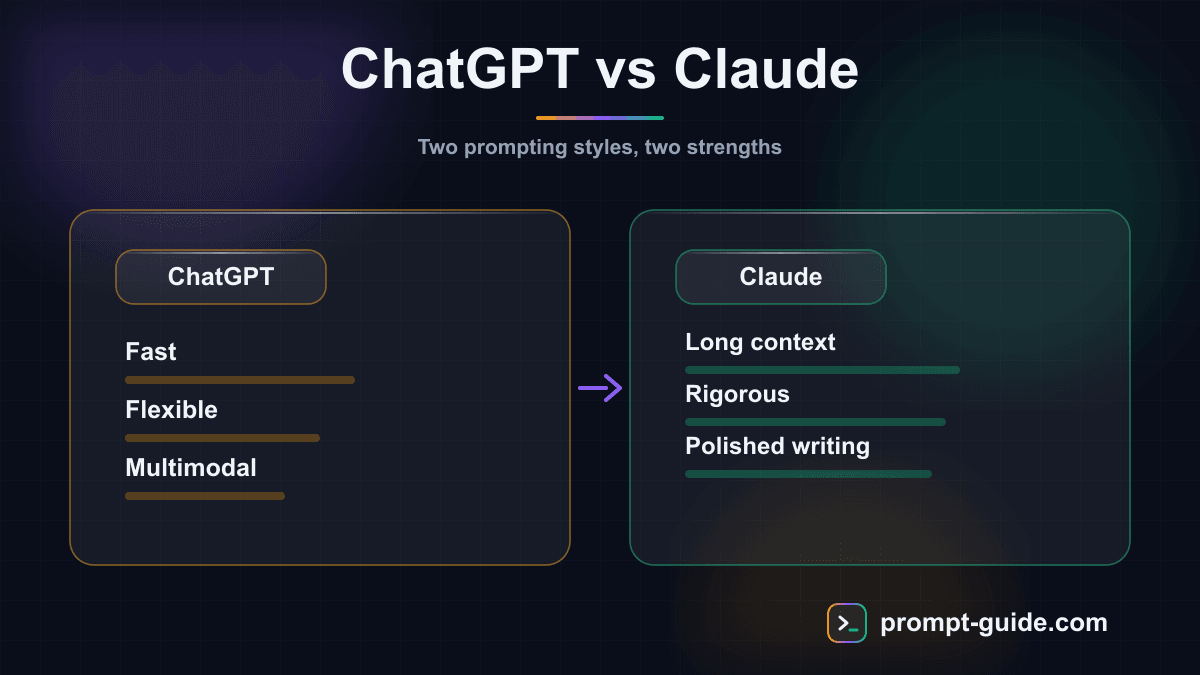
ChatGPT and Claude: two giants, two philosophies
In the world of AI prompting in 2025, two models dominate both consumer and professional markets: ChatGPT (OpenAI) and Claude (Anthropic). While both models can handle most of the same tasks, they differ significantly in their approach, strengths, and how they respond to prompts.
Understanding these differences is not just an academic exercise — it is a concrete strategic advantage. By adapting your prompts to the model you use, you can achieve significantly better results than with a generic prompt.
Introducing the two models
ChatGPT (OpenAI)
ChatGPT is the world's most well-known AI model, launched in November 2022. It is available in multiple versions: GPT-4o (multimodal standard), GPT-4 Turbo (speed/cost optimized), and o1/o3 (reasoning models). Key strengths include its rich ecosystem (custom GPTs, plugins, Bing integration, DALL-E), versatility, multimodality, and conversational memory.
Claude (Anthropic)
Claude is developed by Anthropic, founded by former OpenAI leaders. Current versions include Claude Opus 4 (most capable), Claude Sonnet 4 (best performance/speed ratio), and Claude Haiku (fastest and most economical). Key strengths include precise instruction following, massive context window (up to 1M tokens), high-quality writing, and honest self-assessment of limitations.
Strengths and weaknesses compared
Creativity and writing
- ChatGPT produces more "mainstream" content. Texts are often more dynamic and commercial. Excels at short, punchy formats (slogans, headlines, hooks).
- Claude produces more nuanced and literary content. Better management of nuance and tone. Excels at long, structured texts (articles, reports, analyses).
Reasoning and logic
- ChatGPT (o1/o3): excels at complex math, algorithmic coding, and logic puzzles.
- Claude (Opus/Sonnet): excels at contextual reasoning, text analysis, and nuanced problems. Opus 4 with extended thinking directly rivals o1/o3.
Instruction following
This is an area where Claude has a recognized advantage. Claude generally follows instructions more precisely and literally. If you ask for "exactly 5 points," Claude will almost always deliver 5. Claude respects strict formats and negative constraints more faithfully.
Long document processing
Claude's context window (up to 1M tokens for Opus) provides a major advantage for analyzing large documents, contracts, reports, and codebases.
ChatGPT-specific techniques
- Custom GPTs: create specialized versions with permanent instructions and reference files.
- Plugins and actions: web browsing, Code Interpreter, DALL-E, custom API actions.
- Conversational instructions: ChatGPT excels with naturally worded prompts.
- High temperature for creativity: produces interesting creative output at 0.8-1.0.
Claude-specific techniques
XML tagging: a structural advantage
Claude is specially trained to understand XML markup in prompts. By structuring prompts with XML tags, you get clearer prompts, more precise responses, and measurably better results on complex tasks.
Extended thinking
Claude Opus and Sonnet feature an extended thinking mode that enables deep reflection before responding, similar to OpenAI's o1/o3 thinking mode but with a different approach.
Massive context window
With up to 1M tokens of context, Claude enables prompting techniques impossible with other models: loading entire codebases for architectural analysis, massive few-shot with 50+ examples, and cross-document comparative analysis.
Which model for which use case?
- SEO writing: Claude (better writing quality, better SEO constraint adherence).
- Brainstorming: ChatGPT (more spontaneous, more variety).
- Data analysis: ChatGPT with Code Interpreter.
- Professional coding: Claude Code (autonomous agent, architectural understanding).
- Customer support: Claude (better guideline adherence, more natural tone).
- Translation: Claude (better linguistic nuance management).
- Education: tie (both excellent).
- Automation: Claude via API (more reliable system instructions).
- Multimodal use: ChatGPT (more complete multimodal ecosystem).
Verdict: use both
The best strategy in 2025 is not to choose one model, but to use both complementarily. Each has its strengths, and a savvy user knows which tool to pick for each task. Master model-specific techniques (XML for Claude, GPTs for ChatGPT) and you will get the best from generative AI. The fundamentals (context, constraints, iteration) work across all models — specific techniques are the optimization layer that takes you from good to excellent.
Related Prompts
Build a Complete Marketing Automation Funnel
This prompt generates a complete, operational marketing automation funnel from acquisition to retention, with detailed email sequences and lead scoring.
Create Your First API with Express.js
Learn to create your first Express.js REST API from A to Z with pedagogical explanations adapted to beginners.
Design High-Converting Landing Page Copy
This prompt generates complete landing page copy structured according to CRO best practices, from the headline to the final CTA, covering every stage of persuasion.
Convert my notes into structured documentation
This Cowork prompt gathers your scattered notes from a folder and transforms them into professional documentation. Claude identifies themes, detects inconsistencies and gaps, then produces a structured document with table of contents and cross-references. Incomplete sections are flagged for completion. Every piece of information cites its original source.
Complete Code Review for Pull Requests
Get an exhaustive code review covering quality, performance, security, and maintainability for any language.
Legacy Code Refactoring
Safely and incrementally refactor legacy code following SOLID principles and modern best practices.
Practice Exercises
Clarity and Precision
Learn to write clear and precise prompts to get exactly what you want.
Providing Context
Master the art of giving the right context to AI for relevant results.
Role Prompting
Use role assignment to get expert-level responses.
Few-shot Prompting
Teach by example: guide the AI with concrete examples.
System Prompt Design
Design a complete system prompt for a professional chatbot.
Related guides
Continue your learning
You've finished this guide. Here's how to go further.
Practice what you learned
Interactive exercises to sharpen your prompting skills
Get new guides every week
Join our newsletter and never miss new content.